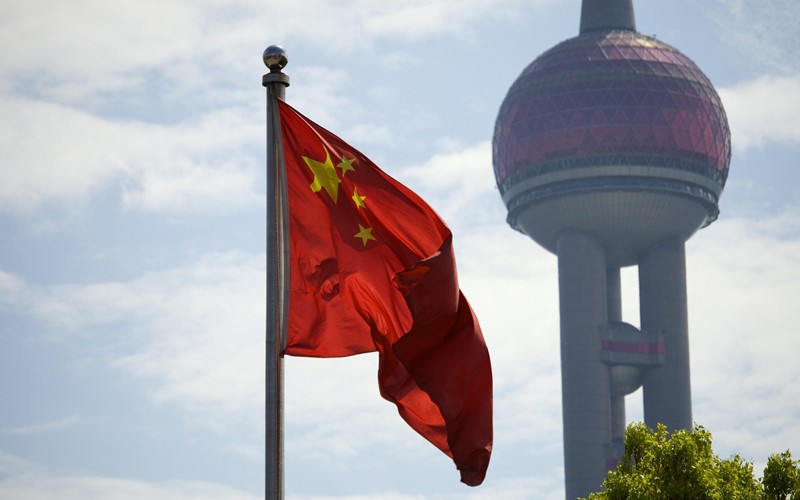
China's services growth slows to 7-month low amid tariff jitters, weak demand: Report
Beijing: China’s services sector grew at its slowest pace in seven months in April, with new business expansion losing steam amid mounting uncertainty from US tariff actions, Reuters reported, citing a private survey released on Tuesday.
The Caixin/S&P Global Services Purchasing Managers’ Index (PMI) dropped to 50.7 in April from 51.9 in March, marking its lowest reading since September.
A PMI reading above 50 indicates expansion, while one below signals contraction.
The figures largely echoed the official survey, which also showed a mild dip in service activity to 50.1 from 50.3.
While the official data covers larger and state-owned firms, the Caixin PMI is viewed as a more accurate gauge of smaller, export-driven enterprises.
Despite a better-than-expected economic performance in the first quarter — buoyed by state-led stimulus — China’s broader economy remains weighed down by persistent deflationary risks, an ongoing property market downturn, and increasing pressure from US tariffs.
The services sector plays a major role in China's economy, employing around 48% of the workforce and contributing 56.7% to the GDP in 2023.
But as US President Donald Trump’s tariff measures intensify, concerns are rising over potential knock-on effects on manufacturing, job creation and consumer sentiment.
“With a cloud over the market outlook, both business and consumer confidence are subdued, making it harder to boost domestic demand,” Wang Zhe, Senior Economist at Caixin Insight Group, was quoted as saying by Reuters.
Wang warned that the consequences of the tariff standoff with the US would become more evident in the coming quarters, urging policymakers to act preemptively.
Demand slows, sentiment dips
New business growth in April slipped to its weakest level since December 2022, according to the Caixin survey, though export orders rose slightly — partly due to a recovery in tourism. Some service providers reported that disruptions in goods trade caused by US tariffs were starting to hurt operations.
Business confidence in the services sector dropped to its lowest since February 2020, with many firms citing US tariffs as a primary concern.
In response to cost pressures and weak demand, service providers reduced their workforce for the second consecutive month, leading to a build-up in unfinished work.
The backlog of work index moved into expansion for the first time in 2024.
Firms also resorted to price cuts to retain customers, even as input costs edged higher.
Overall activity eases
The Caixin China General Composite PMI — which combines manufacturing and services data — fell to 51.1 in April from 51.8 in March, signalling a broader easing in economic activity.
In late April, the Communist Party’s Politburo pledged targeted support for sectors and workers hit hardest by the triple-digit US tariffs, and warned of the need to prepare for worst-case scenarios, Reuters reported.
Economists at Morgan Stanley recently estimated that second-quarter growth could slow by a full percentage point as the impact of tariffs deepens.
“We expect Beijing to navigate the challenges with cautious and uneven stimulus policies: still relying on investment in emerging sectors and urban renewal, while gradually shifting policy towards consumption over the medium term,” the investment bank said.
Support Our Journalism
We cannot do without you.. your contribution supports unbiased journalism
IBNS is not driven by any ism- not wokeism, not racism, not skewed secularism, not hyper right-wing or left liberal ideals, nor by any hardline religious beliefs or hyper nationalism. We want to serve you good old objective news, as they are. We do not judge or preach. We let people decide for themselves. We only try to present factual and well-sourced news.
Support objective journalism for a small contribution.