Declining food prices 'very good' for importing countries UN agricultural agency
The FAO Food Price Index is a trade-weighted index monitoring five commodity group price indices– cereals, meat, dairy products, vegetable oils, and sugar. In October, it dipped to 192.3, technically its seventh consecutive monthly decline, but a marginal 0.2 percent drop from the revised September figure.
The ongoing slight decline in the index is "very good for food importing countries," FAO senior economist Concepción Calpe said in statement.
Dairy prices fell by 1.9 percent, as butter and milk powder prices dipped due to increased output in Europe, where many producers are grappling with Russia's ban on cheese imports. The sub-index for dairy products dropped to 184.3, down 3.5 points from September, and 66.8 points, or 26.6 percent down from October 2013.
Meat prices also broadly declined, as pig production recovered in several countries hit by endemic porcine diarrhoea and growing cattle herds in Australia pushed down beef prices. FAO's Meat Price Index fell by 1.1 percent or 2.3 points from September to 208.9, still more than 10 percent above its level a year ago.
The Cereal Price Index, which fell sharply over the recent months as global wheat and maize production appeared set for record harvests, was broadly stable at 178.4 points in October as maize harvest delays in the United States and deteriorating prospects for Australia's wheat crop led to firmer prices.
Rice prices declined, however, as newly harvested supplies came to market. The cereals sub-index is now down 9.3 percent, or 18.2 points below the level of one year ago.
Overall, the Food Price Index is at its lowest levels since August 2010.
Meanwhile, the Sugar Price Index rose to 237.6 points, a brisk 4.2 percent increase from the previous month, due largely to drought in parts of Brazil, leading to reports that the sugarcane crop will be smaller than expected. Despite the month's gains, international sugar prices remain more than 10 percent below their October 2013 level.
The vegetable oils sub-index rose for the first time since March, clocking in at 163.7 points in October, up 1.0 percent, or 1.6 points from September. Palm oil production slowdowns in Indonesia and Malaysia, combined with a revival in global import demand, sustained the increase.
FAO's monthly Cereal Supply and Demand Brief also released on Thursday trimmed back the Organization's forecast for 2014 world cereal production by about one million tonnes. At 2.5 billion tonnes, the full-year production figure would be 3.7 million tonnes below 2013's record output.
Meanwhile, the forecast for global wheat production has been raised, as output from Ukraine is on track to be higher than previously expected. This growing season's wheat crop is now expected to top last year's record harvest with a total output of 722.6 million tonnes.
For rice, the forecast for global production remains unchanged at 496.3 million tonnes in milled rice equivalent. This would be 0.3 percent less than in 2013, and would mark the first decline since 2009.
Global inventories of all the main cereals remain on course to hit a 15-year high, although the forecast was marked down by 2.7 million tonnes from October's projections to 624.7 million tonnes.
This figure is 8.0 percent above the level at the start of the 2014/15 growing season and would raise the global cereal stock-to-use ratio to a twelve-year high level of 25.1 percent.
Wheat reserves are projected to rise by 9.3 percent this year, while rice inventories are forecast to fall by 2.0 percent, reflecting expected inventory drawdowns, especially in major exporting countries such as India and Thailand.
FAO's November brief also observed that global cereal utilization for direct human consumption is set to expand by 0.9 percent - in line with the global population, leaving per capita consumption stable - while utilization for livestock feed is expected to rise by 2.6 percent.
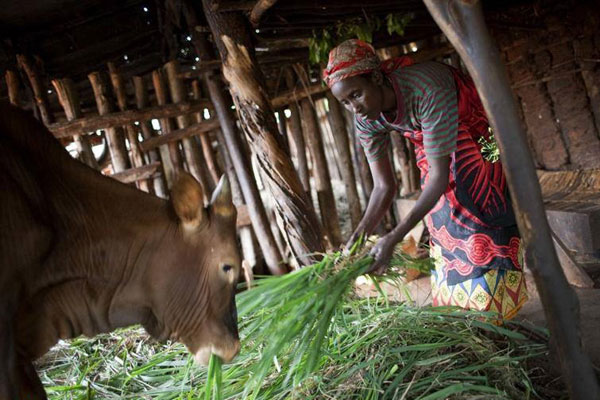
Meat and dairy prices dipped in October 2014 but the global rice harvest is forecast to decline this year. Photo: FAO/Giulio Napolitano
Support Our Journalism
We cannot do without you.. your contribution supports unbiased journalism
IBNS is not driven by any ism- not wokeism, not racism, not skewed secularism, not hyper right-wing or left liberal ideals, nor by any hardline religious beliefs or hyper nationalism. We want to serve you good old objective news, as they are. We do not judge or preach. We let people decide for themselves. We only try to present factual and well-sourced news.
Support objective journalism for a small contribution.