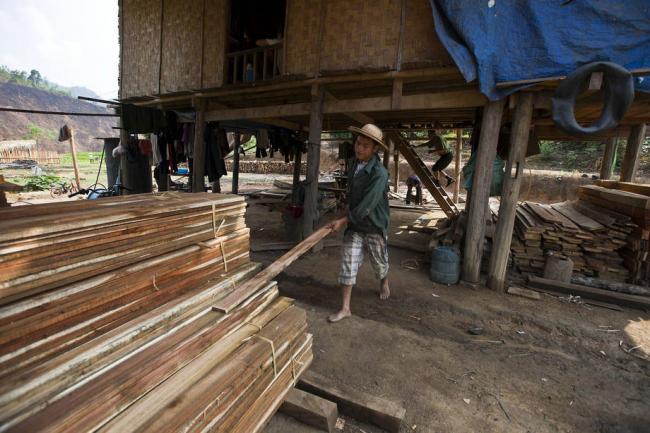
Global wood production in 2014 shows biggest jump since economic crisis, says UN agency
“We are seeing now the highest growth of the global wood industries in the last five years, which is important to national economies and the wellbeing and livelihoods of millions of forest-dependant people worldwide," said said Thais Linhares-Juvenal, head of the FAO’s Forest Economics and Statistics Team, while recognizing that “wood industries were among the hardest hit by the recent global economic downturn in 2008-2009.”
The new statisticsshowed that in 2014, major wood products, such as industrial roundwood, sawnwood, wood-based panels and pulp and paper, have increased from one to five per cent, surpassing the pre-recession levels of 2007. It is also noteworthy that the Asia-Pacific, region, and Latin America and Caribbean have the fastest growth in production.
Production of wood pellets, mainly used as fuel, increased dramatically in recent years, setting a new record in 2014 and growing by 16 per cent over the previous year, reaching 26 million metric tonnes. Europe and North America accounted for most global production and consumption, while the situation in Asia more than doubled in 2014 over the previous year, said the data.
The study also noted that in 2014, paper production stagnated in Europe and declined in North America, due to the prevailing use of social media. China, however, is by far the largest producer and consumer of paper and wood-based panels. Its paper production and consumption resumed growth in 2014, after a pause in 2013, driving the overall growing trend in the Asia-Pacific region.
Turing to wood-based panels and sawnwood, the study noted there has been a worldwide strong gain in both production and consumption, with wood-based panels surged most in production by six per cent, according to the report, revealed the report.
South America, attributed for 30 per cent of worldwide exports of wood pulp, has gradually emerged as a new ‘big player’ in the global market, with new mills being built in Brazil, Chile, and Uruguay.
The Statistical Yearbook of Forest Products, published by FAO annually, aims to provide countries with informative tools to assess the forest products to global and national economies and sustainable development, and to improve their forest management and forestry policies.
Photo: FAO/Joan Manuel Baliellas
Support Our Journalism
We cannot do without you.. your contribution supports unbiased journalism
IBNS is not driven by any ism- not wokeism, not racism, not skewed secularism, not hyper right-wing or left liberal ideals, nor by any hardline religious beliefs or hyper nationalism. We want to serve you good old objective news, as they are. We do not judge or preach. We let people decide for themselves. We only try to present factual and well-sourced news.
Support objective journalism for a small contribution.