August 17, 2026 09:01 am (IST)

Follow us:


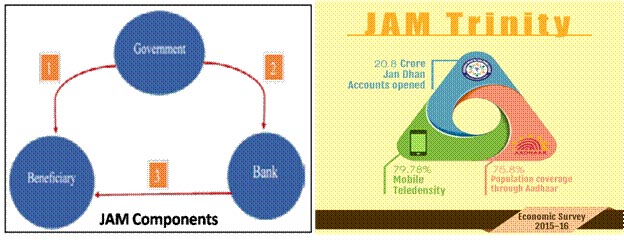
Jandhan, Aadhaar, Mobile: For better implementation of Direct Benefit Transfers
New Delhi, Feb 26 (IBNS) The Economic Survey 2015-16 presented on Friday in the Parliament by the Union Finance Minister Arun Jaitley stated that the three methods, Jandhan, Aadhaar, and Mobile (JAM or JAM Trinity as mentioned during the presentation) can help the government to implement large-scale, technology-enabled and real-time Direct Benefit Transfers (DBTs) to improve economic lives of India’s poor.
The Survey said that PAHAL, the scheme of transferring LPG subsidies via DBT has reduced leakages by 24 per cent.
The Economic Survey suggested that while deciding where next toapply JAM, policy makers should consider the challenges of beneficiary identification, distributor opposition and beneficiary financial inclusion. Spreading JAM to other areas will reduce leakages and provide more fiscal space to the government.
JAM components:
Economic Survey divides JAM into three components-
1. Identification or First-Mile: Identification of beneficiaries by government
2. Transfer or Middle-Mile: Transfer of fund to beneficiaries by government
3. Access or Last-Mile: Access of fund by beneficiaries
Identification:
First-mile deals with identification of beneficiary. This layer has issues of ghost and duplicate names due to administrative and political discretion and use of pre-Aadhaar database. It is easier to implement the JAM for universal schemes than targeted ones as identification will be easier. Identification of household-individual connection is important to note here as some schemes target at household level like JDY and some at individual level like Aadhaar. Aadhaar can help in better identification of the beneficiaries.
Transfer:
Middle-mile deals with the challenges of payment where government transfer benefits to the banks. But lack of bank accounts and its information with government hinders the middle-layer connectivity. Main issue in this layer is of within-government coordination and dealing with supply chain interest groups. Jandhan can help beneficiaries to have bank accounts.
Access:
Last-mile layer faces issues of lesser bank penetration, mostly in rural areas. It deals with actual transfer of money from Bank to Beneficiary accounts. It also deals with issues of exclusion of genuine beneficiaries. Mobile can inform about benefits and also allow easier fund transfer.
Where next?
Economic Survey said that policy makers should decide where to apply JAM based on two considerations:
1. Amount of leakages
2. Control of the central government.
If the leakage amount in a given scheme/area is huge, then it can be the next target for introduction of JAM as subsidies with higher leakages will have larger returns from introducing JAM.
Similarly control of central government will reduce administrative challenges of co-ordination and political challenges of opposition by interest groups.
Based on these two criteria- leakages and central government control-Survey suggested that fertilizer subsidies and within-government transfers as two most promising areas for introduction of the JAM.
JAM Preparedness Index:
The Economic Survey has formulated JAM-Preparedness Indices for Urban and Rural areas in each state. It uses Aadhaar penetration, basic bank account penetration and Banking Correspondents (BC) density as indicators for the indices.
It has also prepared Biometrically Authenticated Physical Update or BAPU-Preparedness Index, using Aadhaar penetration and Point of Sale machines as indicators, for each state and has compared Rural-JAM Preparedness Index with BAPU-Preparedness Index.
The Survey has found that many states are having higher scores in BAPU-Preparedness Index as compared to Rural JAM-Preparedness Index. Thus it suggests use of BAPU as short-term solution to reduce the leakages in these states, till states are well prepared for introduction of the JAM.
The Economic Survey concluded that introduction of DBT in LPG and MGNREGS have proved that use of JAM can considerably reduce leakages, reduce idle funds, lower corruption and improve ease of doing business with the government.
Despite huge improvements in financial inclusion due to Jandhan, JAM Preparedness indicators suggest that there is still a long way to go.
Center can invest in last-mile financial inclusion via further improving BC networks and promoting the spread of the mobile money. In the meantime models like BAPU can be used as an alternative to reduce the leakages.
Support Our Journalism
We cannot do without you.. your contribution supports unbiased journalism
IBNS is not driven by any ism- not wokeism, not racism, not skewed secularism, not hyper right-wing or left liberal ideals, nor by any hardline religious beliefs or hyper nationalism. We want to serve you good old objective news, as they are. We do not judge or preach. We let people decide for themselves. We only try to present factual and well-sourced news.
Support objective journalism for a small contribution.

Latest Headlines
Mahindra launches BLAZO i-TRK: All details inside
Sun, Aug 16 2026
Reliance Industries, Rolls-Royce join hands to explore indigenous engine for India’s AMCA fighter
Sat, Aug 15 2026
BSNL’s Independence Day gift: Re 1 Recharge, 412-Day Plan and 500 Free TV Channels. Check now
Sat, Aug 15 2026
Emami’s big snack bet: ₹750 crore investment, new WeMe brand targets ₹1,000 crore in 3-5 years
Sat, Aug 15 2026
HCG Q1 results: Cancer care major posts 190% jump in adjusted profit, revenue rises 13%
Fri, Aug 14 2026
Big relief for Zee Entertainment: SAT allows warrants issue, dividend access despite SEBI ban
Fri, Aug 14 2026
Olectra Greentech Q1 shocker: Revenue soars 66%, profit barely moves; shares crash 4%
Fri, Aug 14 2026
Red Friday on Dalal Street: Sensex plunges 300 points, Nifty slides amid geopolitical tensions
Fri, Aug 14 2026
Tata Motors shares jump 6% after Q1 profit soars 83% to ₹2,560 crore
Thu, Aug 13 2026