October 05, 2026 09:08 am (IST)

Follow us:


 Crude Oil
Oil prices jump above $103 a barrel as US moves to block Iran-linked shipping
Global oil markets rallied sharply after US President Donald Trump announced a naval blockade targeting Iran-linked shipping, triggering renewed concerns over supply disruptions.
Brent crude, the international oil benchmark, climbed more than 8 percent on Sunday, breaching the $103 per barrel mark.
The surge marked a return above the key $100 threshold for the first time since earlier in the week, when prices had briefly exceeded $111 per barrel.
Hormuz blockade plan
The announcement followed the collapse of ceasefire negotiations between US and Iranian officials over the weekend.
Hormuz blockade plan
The announcement followed the collapse of ceasefire negotiations between US and Iranian officials over the weekend.
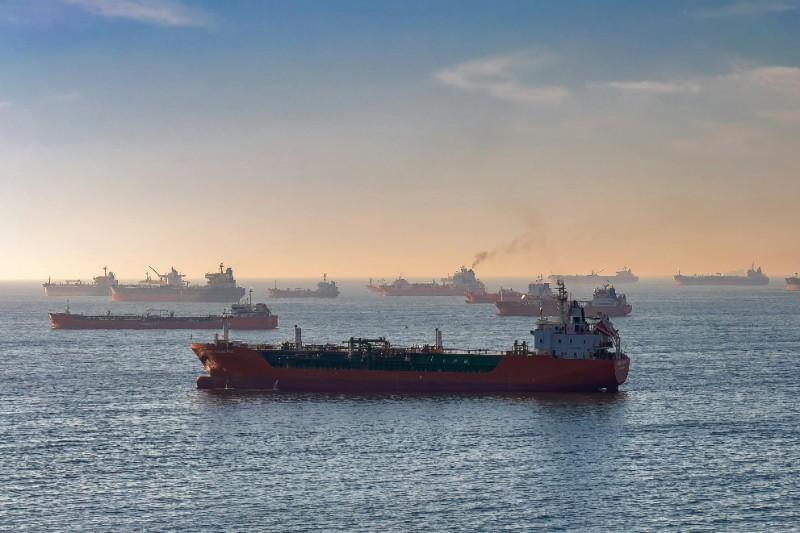
Trump stated that the US Navy would prevent vessels from entering or leaving the Strait of Hormuz, a critical global energy corridor.
However, United States Central Command later clarified that the operation would specifically target ships travelling to and from Iran, indicating a more limited scope than initially suggested.
However, United States Central Command later clarified that the operation would specifically target ships travelling to and from Iran, indicating a more limited scope than initially suggested.
Other maritime traffic, it said, would not face restrictions.
The command added that the measure would come into force on Monday at 10 am Eastern Time (14:00 GMT/1930 IST).
Oil markets react to renewed supply risks
Oil prices have experienced significant volatility in recent weeks.
The command added that the measure would come into force on Monday at 10 am Eastern Time (14:00 GMT/1930 IST).
Oil markets react to renewed supply risks
Oil prices have experienced significant volatility in recent weeks.
Earlier tensions escalated after joint US-Israeli strikes on Iran led Tehran to impose what amounted to a partial blockade of the Strait of Hormuz, through which roughly one-fifth of global oil and natural gas supplies pass.
Brent crude had surged to above $119 per barrel last month before retreating below $92 last week, following the announcement of a temporary two-week ceasefire between Washington and Tehran after more than six weeks of conflict.
Shipping activity remains severely disrupted
Despite the ceasefire remaining officially in place until April 22, maritime traffic through the strait has yet to recover. Iran has permitted limited vessel movement, subject to prior approval, but volumes remain sharply reduced.
Data from Windward showed that only 17 ships transited the strait on Saturday, a steep decline from the typical daily average of around 130 vessels before the conflict.
Asian markets decline
Financial markets in Asia reacted negatively to the developments, reflecting heightened geopolitical risk and uncertainty over global energy supplies.
Japan’s Nikkei 225 fell 0.9 percent in early trading, while South Korea’s KOSPI dropped more than 1 percent.
Brent crude had surged to above $119 per barrel last month before retreating below $92 last week, following the announcement of a temporary two-week ceasefire between Washington and Tehran after more than six weeks of conflict.
Shipping activity remains severely disrupted
Despite the ceasefire remaining officially in place until April 22, maritime traffic through the strait has yet to recover. Iran has permitted limited vessel movement, subject to prior approval, but volumes remain sharply reduced.
Data from Windward showed that only 17 ships transited the strait on Saturday, a steep decline from the typical daily average of around 130 vessels before the conflict.
Asian markets decline
Financial markets in Asia reacted negatively to the developments, reflecting heightened geopolitical risk and uncertainty over global energy supplies.
Japan’s Nikkei 225 fell 0.9 percent in early trading, while South Korea’s KOSPI dropped more than 1 percent.
The Indian stock market plunged sharply on Monday, with the BSE Sensex falling over 1,500 points and the NSE Nifty 50 dropping nearly 400 points.
US stock futures also edged lower, with contracts linked to the S&P 500 declining by approximately 0.8 percent in off-hours trading.
US stock futures also edged lower, with contracts linked to the S&P 500 declining by approximately 0.8 percent in off-hours trading.
#oil prices
# Brent crude
# US Iran blockade
# Strait of Hormuz crisis
# Donald Trump oil
# global oil surge
# shipping disruption
# energy markets
# geopolitical tensions
# stock market reaction
Support Our Journalism
We cannot do without you.. your contribution supports unbiased journalism
IBNS is not driven by any ism- not wokeism, not racism, not skewed secularism, not hyper right-wing or left liberal ideals, nor by any hardline religious beliefs or hyper nationalism. We want to serve you good old objective news, as they are. We do not judge or preach. We let people decide for themselves. We only try to present factual and well-sourced news.
Support objective journalism for a small contribution.



Latest Headlines
‘Pipeline between Delhi and Bengal is clear’: Jitin Prasada outlines Centre’s push for Bengal growth at ICC session
Fri, Oct 02 2026
Park Street gets a new jewellery destination: Bluestone opens flagship store with luxury Indo-contemporary design
Fri, Oct 02 2026
Adani’s Colombo Port expansion gets Sri Lankan PM’s nod: $750 million project unveiled
Fri, Oct 02 2026
Adani Green hits major battery storage milestone: 6.63 GWh BESS now operational in Gujarat
Fri, Oct 02 2026