PM Modi interacts with economists at NITI Aayog, calls for mission-mode reforms for Viksit Bharat
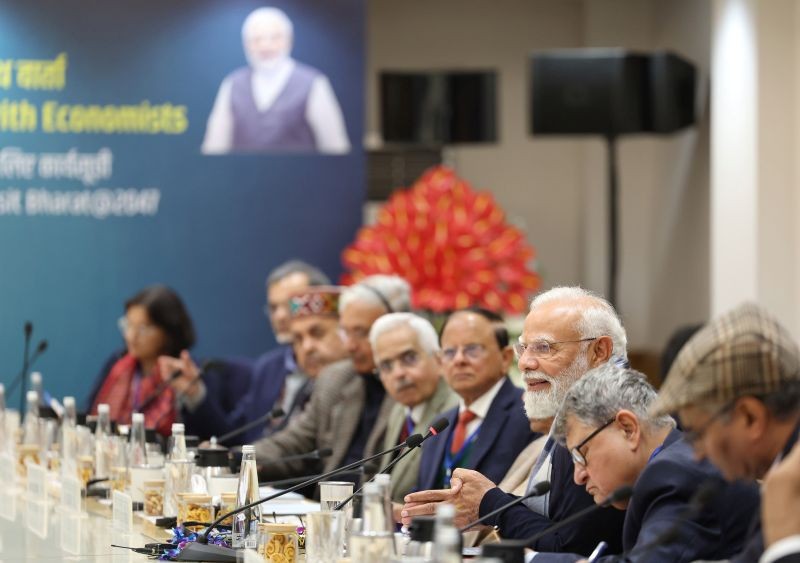
Prime Minister Narendra Modi on Monday interacted with a group of eminent economists and experts at NITI Aayog, with discussions centred on the theme ‘Aatmanirbharta and Structural Transformation: Agenda for Viksit Bharat’.
Addressing the gathering, the Prime Minister outlined the core pillars of India’s journey towards becoming a developed nation by 2047, describing Viksit Bharat as a national aspiration that has moved beyond government policy to become a mass movement.
He said the changing aspirations of citizens were reflected in evolving patterns of education, consumption and global mobility, underlining the need for stronger institutional capacity and proactive infrastructure planning to meet the demands of a more aspirational society.
The Prime Minister stressed the importance of mission-mode reforms across sectors to build global capabilities and ensure deeper integration with international markets.
He said policymaking and budgeting decisions must remain firmly anchored to the long-term vision of 2047 to sustain high growth over the coming decades.
Highlighting India’s growing role in the global economy, the Prime Minister also spoke about the need to ensure that the country remains a key hub for the global workforce and international markets.
During the interaction, the economists and experts shared strategic insights on enhancing productivity and competitiveness in both manufacturing and services.
The discussions focused on accelerating structural transformation through higher household savings, robust infrastructure development and the adoption of cutting-edge technologies.
The role of artificial intelligence (AI) as a catalyst for cross-sectoral productivity gains was also examined, along with the continued expansion and scaling of India’s Digital Public Infrastructure (DPI).
Participants noted that the series of cross-sectoral reforms undertaken in 2025, and their expected consolidation in the coming year, would strengthen India’s economic foundations and help the country remain among the fastest-growing major economies globally.
Several noted economists and experts took part in the discussion, including Shankar Acharya, Ashok K Bhattacharya, N R Bhanumurthy, Amita Batra, Janmejaya Sinha, Amit Chandra, Rajani Sinha, Dinesh Kanabar, Basanta Pradhan, Madan Sabnavis, Ashima Goyal, Dharmakirti Joshi, Umakant Dash, Pinaki Chakraborty, Indranil Sen Gupta, Samiran Chakraborty, Abhiman Das, Rahul Bajoria, Monika Halan and Siddhartha Sanyal.'
Support Our Journalism
We cannot do without you.. your contribution supports unbiased journalism
IBNS is not driven by any ism- not wokeism, not racism, not skewed secularism, not hyper right-wing or left liberal ideals, nor by any hardline religious beliefs or hyper nationalism. We want to serve you good old objective news, as they are. We do not judge or preach. We let people decide for themselves. We only try to present factual and well-sourced news.
Support objective journalism for a small contribution.