October 05, 2026 06:08 pm (IST)

Follow us:


 Atmanirbhar Bharat
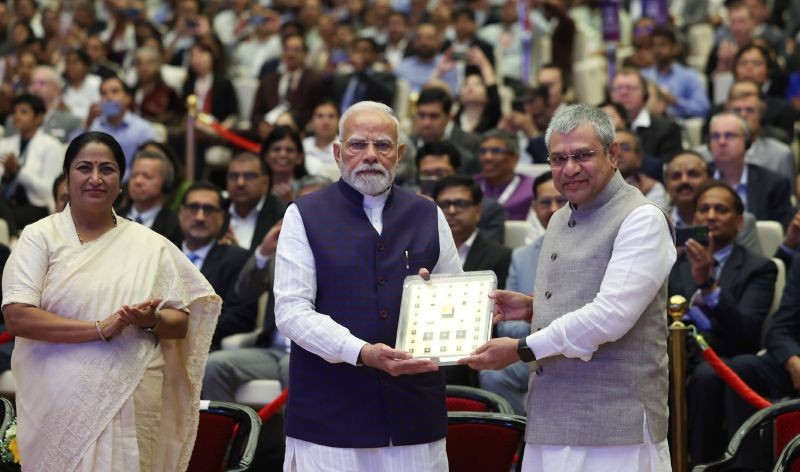
PM Modi receives first Made-in-India semiconductor chip in giant step towards Atmanirbhar Bharat
New Delhi/IBNS: In a big step towards Atmanirbhar Bharat amid tariff war with the US, Prime Minister Narendra Modi on Tuesday received the first domestically produced semiconductor chip.
First ‘Made in Bharat’ Chips! 🇮🇳 pic.twitter.com/QYFGA4HFLG
— Ashwini Vaishnaw (@AshwiniVaishnaw) September 2, 2025
The Prime Minister was present to inaugurate the Semicon India 2025.
India's Electronics & Information Technology Minister Ashwini Vaishnaw showcased India’s first fully indigenous 32-bit microprocessor, named “Vikram”, along with test chips from approved semiconductor projects.
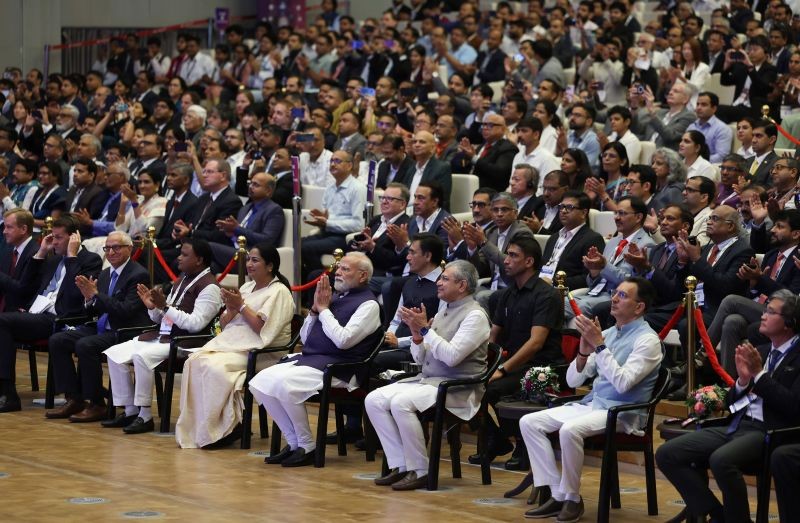 PM Modi seated at the Semicon India 2025 inauguration event. Photo: PIB
In a vision for a $100–110 Billion Semiconductor Market by 2030: The PM projected that India’s semiconductor market could reach this scale as the ecosystem matures.
Modi, who returned from a Japan and China visit on Monday, said, "Semicon India 2025 sends a powerful message: the world trusts India, the world believes in India, and the world is ready to build the semiconductor future with India. I warmly welcome all of you. You are important partners in the journey of Viksit Bharat and Atmanirbhar Bharat."
The Prime Minister, who restructured India's ties with China and bolstered the equation with Japan, touched upon the GDP figure for the first quarter- that is recorded at 7.8%.
"The GDP numbers for the first quarter of this year have once again proven that Bharat has performed beyond every expectation and estimate," said Modi.
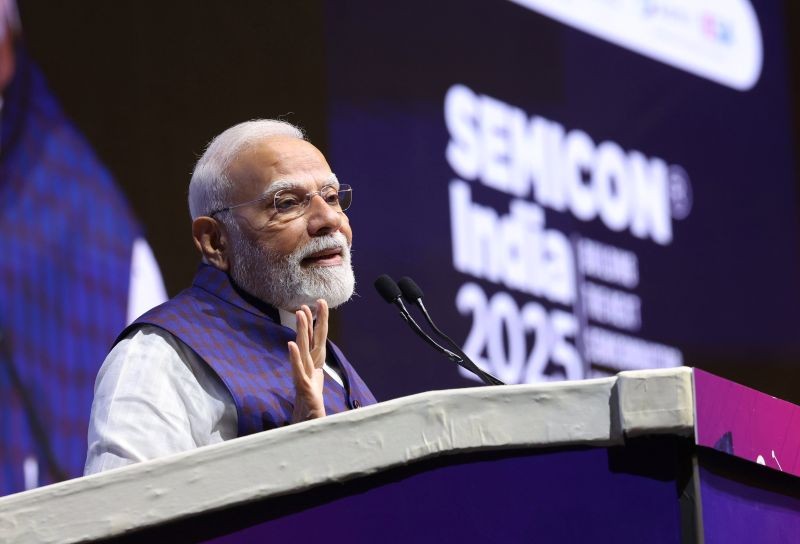 PM Modi addressing the gathering. Photo: PIB
 In the backdrop of the India-US tariff war, the Prime Minister added, "On one hand, many of the world’s economies are facing uncertainty and challenges related to economic selfishness. Yet, in this environment, Bharat has achieved a remarkable growth rate of 7.8 percent. This growth is visible across all sectors, and it brings a unique enthusiasm to our citizens. With this momentum, we are well on our way to becoming the world’s third-largest economy."
Key details of Vikram
- The chip, named “Vikram”, is India’s first fully indigenous 32-bit microprocessor, developed by ISRO’s Semiconductor Laboratory (SCL).
- It is designed to operate in harsh launch-vehicle conditions, indicating its industrial-grade resilience.
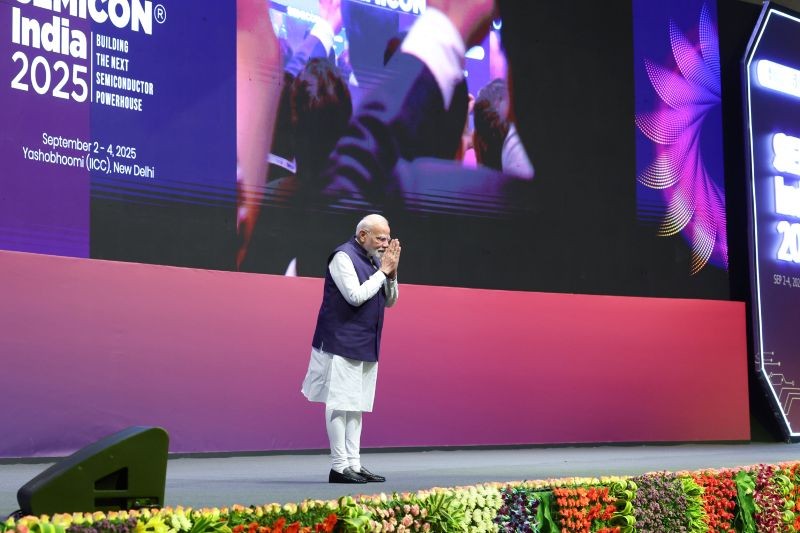 PM Modi at Semicon India 2025. Photo: PIB
Context and ecosystem push
- Launched under the India Semiconductor Mission (2021), this chip marks a milestone achieved in under 3.5 years.
- It comes alongside a thriving Production Linked Incentive (PLI) framework worth ₹76,000 crore—of which ₹65,000 crore is committed.
- The OSAT pilot line in Sanand, Gujarat, is expected to roll out the first ‘Made in India’ chip via CG-Semi later this year.
In Summary
- Vikram is a landmark in India’s semiconductor timeline—proof of indigenous innovation and manufacturing.
- It signals India’s intent to move from being a tech consumer to a tech creator, with implications across defense, space, and global chip supply chains.
- Alongside ventures like IRIS, India is laying foundational blocks—not just for chips, but for self-reliance in critical tech.
#Semicon India 2025
# Narendra Modi
# Made-In-India Semiconductor chip
# Semiconductor Chip
# Vikram
# Atmanirbhar Bharat
Support Our Journalism
We cannot do without you.. your contribution supports unbiased journalism
IBNS is not driven by any ism- not wokeism, not racism, not skewed secularism, not hyper right-wing or left liberal ideals, nor by any hardline religious beliefs or hyper nationalism. We want to serve you good old objective news, as they are. We do not judge or preach. We let people decide for themselves. We only try to present factual and well-sourced news.
Support objective journalism for a small contribution.
Latest Headlines
myTVS’ technology and scalable platform model attracts strategic investment from Crescent Enterprises
Mon, Oct 05 2026
IT integrated network solutions provider Bench Mark Infotech Services gets listed at NSE Emerge
Mon, Oct 05 2026
Hisense India announces up to 40 percent discounts on TVs during Amazon Great Indian Festival and Flipkart Big Billion Days
Mon, Oct 05 2026
Assam’s river trade makes a historic comeback after 70 years, first cargo heads to Bangladesh
Mon, Oct 05 2026
‘Pipeline between Delhi and Bengal is clear’: Jitin Prasada outlines Centre’s push for Bengal growth at ICC session
Fri, Oct 02 2026