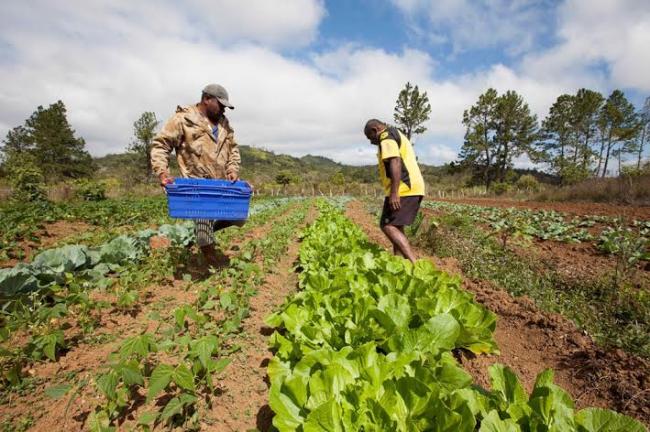
Small farmers can be major actors in reducing agriculture's carbon footprint - UN agency
“What this report shows is that smallholder farmers are a key part of the solution to the climate change challenge,” said Michel Mordasini, Vice President of International Fund for Agricultural Development (IFAD). “With the right investments, smallholders can feed a growing planet while at the same time restoring degraded ecosystems and reducing agriculture's carbon footprint.”
IFAD chose UNESCO's Our Common Future under Climate Change Science Conference in Paris to release details of its latest research with the Research Program on Climate Change, Agriculture and Food Security of the Consultative Group on International Agricultural Research (CGIAR).
The study finds reducing emissions may not be as big a burden as some may believe and could be another benefit of adaptation activities. The study, released today, examines IFAD's portfolio of projects focused on making smallholder agriculture more resilient to climate change.
The Mitigation Advantage Report shows that thirteen IFAD-supported adaptation projects could reduce CO2e emissions by 30 million tons. This represents about 38 per cent of IFAD's target to reduce 80 million tons of CO2e by 2020 under its Adaptation for Smallholder Agriculture Programme. Launched in 2012, this program has become the largest global financing source dedicated to supporting the adaptation of poor smallholder farmers to climate change.
Whilst IFAD's investments are focusing on the key priorities of rural poverty reduction, climate change adaptation and food security, the mitigation target set by the organisation shows how resilient, climate-smart agriculture can make a substantive contribution to the global fight to curb greenhouse gas emissions.
IFAD's climate change adaptation initiatives include improved agronomic practices, afforestation and rehabilitation of degraded lands. These practices help address farmers' immediate needs, like dealing with unpredictable rains, and gradual shifts in crop suitability.
If smallholder adaptation can help reduce global emissions, there could be new opportunities, according to Sonja Vermeulen, Head of research at the CGIAR program.
“Currently over 90 per cent of public and private climate funds go to mitigation, not adaptation. For future food security it would be very helpful if the majority of the world's farmers, who are smallholders, could access those funds,” she said.
Photo: IFAD/Susan Beccio
Support Our Journalism
We cannot do without you.. your contribution supports unbiased journalism
IBNS is not driven by any ism- not wokeism, not racism, not skewed secularism, not hyper right-wing or left liberal ideals, nor by any hardline religious beliefs or hyper nationalism. We want to serve you good old objective news, as they are. We do not judge or preach. We let people decide for themselves. We only try to present factual and well-sourced news.
Support objective journalism for a small contribution.