

 Agriculture in India
Solar-powered pest control system developed by IIT Kharagpur for smaller farm fields
Kharagpur(WB)/IBNS: Researchers at IIT Kharagpur have developed an energy-efficient pest controlling device for smaller agricultural tracts owned by marginal farmers.
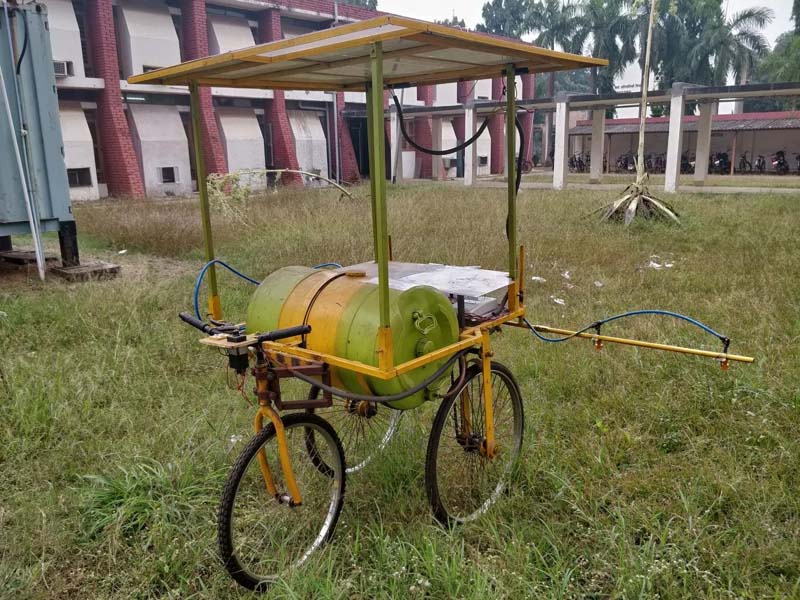
The self-propelled boom-type sprayer can be operated using solar energy and can be safely guided through the crops in smaller tracts of land.
The device is aimed to increase field capacity and uniformity in liquid spraying and also to reduce drudgery to the operator and dependency on fossil fuel for carrying out spraying in cropped areas, the researchers said.
Prevention of pests and diseases during different growth stages of crops is an important process to increase its yield.
For larger tracts of farmlands, tractor mounted sprayers are used, while manually operated knapsack sprayer is used for smaller tracts.
This impacts the efficiency of spraying as it depends on the skill of the operator leading to non-uniformity in spraying.
Further, it requires intensive labour capacity and operation time.
Using tractor-mounted sprayers in smaller tracts on the other hand would make the crops prone to damages due to their higher turning radius.
Also, it leads to the wastage of chemicals due to lower control on automated spraying and also results in environmental pollution due to the fuel emissions from the tractor.
About 82 per cent of the farming community are categorized as small or marginal as per the United Nations' Food and Agriculture Organisation (FAO) with landholding less than 2 hectares [Source: Ministry of Agriculture & Farmers Welfare, Govt. of India, 2019].
Prof. Virendra K Tewari, Director, IIT Kharagpur, said that in the IIT system, IIT Kharagpur has the sole distinction of having an Agricultural & Food Engineering Department. Hence it is their responsibility to join in the government’s efforts to shift from a production-centric approach to income-centric initiatives for farmers, with a focus on better and new technological solutions.
The semi-automated device, developed by Prof. Hifjur Raheman, Anup Behera Rahul K and Prof. P.B.S. Bhadoria from the Dept. of Agricultural and Food Engineering at IIT Kharagpur, will address several challenges of mechanized pest control systems in the small farm sector.
The system comprises a propelling unit fitted with a liquid storage tank, a DC motor operated pump to pressurize the liquid to be sprayed.
Multiple numbers of spray nozzles are mounted on a boom fitted to the front of the machine to cover wider width at a time.
A set of solar-powered batteries act as the power source of the DC motor to propel the spraying unit as well as for running the pump.
Unlike a knapsack sprayer, the liquid storage tank is of bigger capacity and it is carried on a solar-powered three-wheeler trolley.
An operator is required to control the movement of the spraying unit.
A simple arrangement has been provided to vary the height of spraying (i.e., nozzle height from the ground) to carry out spraying for different heights of crops.
Solar panels are mounted on top of the machine to provide continuous power supply during operation through the Maximum Power Point Tracker controller and it also provides shade to the operator during spraying in the field.
Prof. Raheman said, “As compared to conventional knapsack sprayers, the developed sprayer has a higher field capacity and more uniformity of spraying with less drudgery to the operator. It can be easily operated in the field using solar energy with a maximum speed of 2 km/h and can cover a width of 1.5 metre at a time with a field efficiency of 81 per cent thus saving time, human involvement and chemicals,”
The researchers have filed a patent for the product and the product is ready for commercialization.
Director Tewari, who is also a leading expert in the field of farm machinery and power engineering said, “We have developed several such technologies covering micro-irrigation, shade net cultivation and food processing at the Dept. of Agricultural and Food Engineering which are in use in various villages across the 23 districts of West Bengal and other states in eastern India, covering almost 20,000 farmers.”
Support Our Journalism
We cannot do without you.. your contribution supports unbiased journalism
IBNS is not driven by any ism- not wokeism, not racism, not skewed secularism, not hyper right-wing or left liberal ideals, nor by any hardline religious beliefs or hyper nationalism. We want to serve you good old objective news, as they are. We do not judge or preach. We let people decide for themselves. We only try to present factual and well-sourced news.
Support objective journalism for a small contribution.