UN official calls for economic diversification for Asia's landlocked developing countries
“Policies must maintain a competitive exchange rate, neutralizing tendencies towards appreciation and a stable macroeconomic environment with favourable credit conditions for the promotion of new economic activities,” said Shamshad Akhtar, Executive Secretary of ESCAP, during the launch of the Economic Diversification in Asian LLDCs: Prospects and Challenge report at the Second UN Conference on LLDCs, which wraps up today in Vienna, Austria.
Ms. Akhtar underscored that ESCAP’s research revealed that the more diversified the economy, the higher it’s gross domestic product and the lower the competition it faces in global markets. Results in the new report show that diversification moves in short steps, rather than large jumps, and that diversification is a path-dependent process, so that what a country produces today influences what sectors can emerge or develop in the immediate future.
“Some pathways can lead to new products, further diversification and improvement in a country’s productive capacity, whilst other paths spin off relatively fewer opportunities, providing less potential for economic growth and diversification,” she explained.
Recognizing these challenges, ESCAP has mapped the diversification paths to support policymaking in promoting economic diversification, Ms. Akhtar said. In particular, ESCAP’s report shows policymakers how to identify paths to diversification, as well as offers a methodology for identifying diversification opportunities.
Specifically, ESCAP’s analysis identifies the top export markets for potential new products from Asian LLDCs, along with new sectors to increase chances for success in diversification. Most product diversification opportunities for Asian LLDCs exist in five industries: base metals, chemicals, machinery and electrical equipment, plastic and rubber, and textiles, she noted.
While trade links with Europe and North America remain very important, Dr. Akhtar emphasized that the Asia-Pacific region also offers about a quarter of the export opportunities for potential new products of these sectors.
In terms of industrial policy, ESCAP recommends that new economic activities be promoted with the appropriate intervention, including industrial estates and economic zones. ESCAP also calls for Asian LLDCs to create a diversified, well-regulated and inclusive financial system that provides access to a variety of services and products in support of private investment for new economic activities.
The Second UN Conference on LLDCs, which opened on 3 November, brings together business leaders, government officials from LLDCs and transit countries, development partners and senior officials from international organizations to exchange views on the challenges and opportunities faced by LLDCs and develop a new strategic framework for the next 10 years.
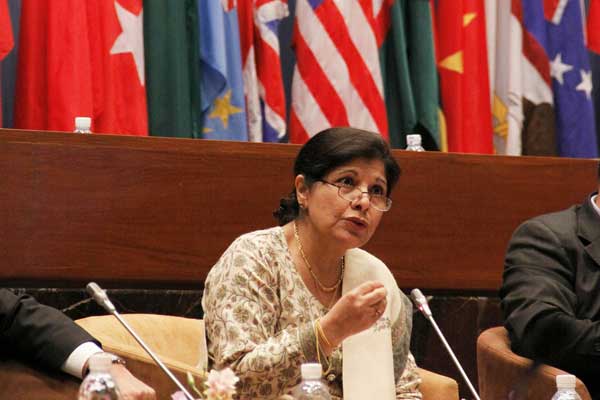
ESCAP Executive Secretary Shamsahd Akhtar. Photo: UNESCAP/Christian Dohrmann
Support Our Journalism
We cannot do without you.. your contribution supports unbiased journalism
IBNS is not driven by any ism- not wokeism, not racism, not skewed secularism, not hyper right-wing or left liberal ideals, nor by any hardline religious beliefs or hyper nationalism. We want to serve you good old objective news, as they are. We do not judge or preach. We let people decide for themselves. We only try to present factual and well-sourced news.
Support objective journalism for a small contribution.