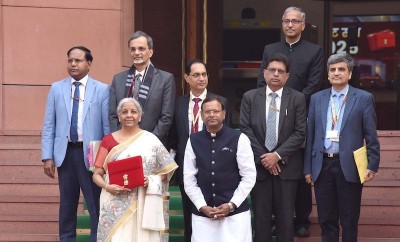
Union Cabinet clears ₹1-trillion RDI Scheme to boost private-sector innovation in deep-tech, AI and green industries
New Delhi: In a major push to bolster private-sector research and innovation, the Union Cabinet on Tuesday approved a ₹1-trillion corpus for the Research Development and Innovation (RDI) Scheme.
The move is aimed at encouraging long-term, low-cost funding for high-growth, strategic sectors such as deep-tech, artificial intelligence, and green technologies.
According to a government statement, the RDI Scheme seeks to fill critical funding gaps in private-sector R&D by offering growth and risk capital to ‘sunrise sectors’.
The scheme acknowledges the essential role of private enterprise in driving innovation and translating research into viable commercial products.
Structured in two tiers, the scheme will first establish a Special Purpose Fund (SPF) under the Anusandhan National Research Foundation (ANRF), which will manage the ₹1-trillion corpus. In the second phase, fund managers will channel these resources to specific R&D projects — either as long-tenure loans with low or nil interest or via equity infusions in innovation-led start-ups.
Additionally, the scheme may contribute to a ‘Deep-Tech Fund of Funds’, which will operate as a pooled investment vehicle targeting ventures aligned with cutting-edge technology and national innovation goals.
The fund was first introduced in the FY25 Budget, where Finance Minister Nirmala Sitharaman had allocated ₹20,000 crore to the Department of Science and Technology (DST) for this purpose. Since 2014, DST’s budget has increased nearly tenfold — from ₹2,777 crore to ₹28,509 crore in FY26.
Gross expenditure on R&D has also doubled, from ₹60,196 crore to ₹1,27,380 crore in the same period.
By providing patient, low-cost capital to high-potential sectors, the RDI Scheme is expected to transform India’s research ecosystem, attract private investment, and help the country compete globally in future-defining technologies.
Support Our Journalism
We cannot do without you.. your contribution supports unbiased journalism
IBNS is not driven by any ism- not wokeism, not racism, not skewed secularism, not hyper right-wing or left liberal ideals, nor by any hardline religious beliefs or hyper nationalism. We want to serve you good old objective news, as they are. We do not judge or preach. We let people decide for themselves. We only try to present factual and well-sourced news.
Support objective journalism for a small contribution.