 Pulse Tariff
Will dal disrupt diplomacy? US lawmakers urge Trump to act on India’s 30% pulse tariff
Negotiations over the India-US trade agreement could once again face turbulence, this time over pulses.
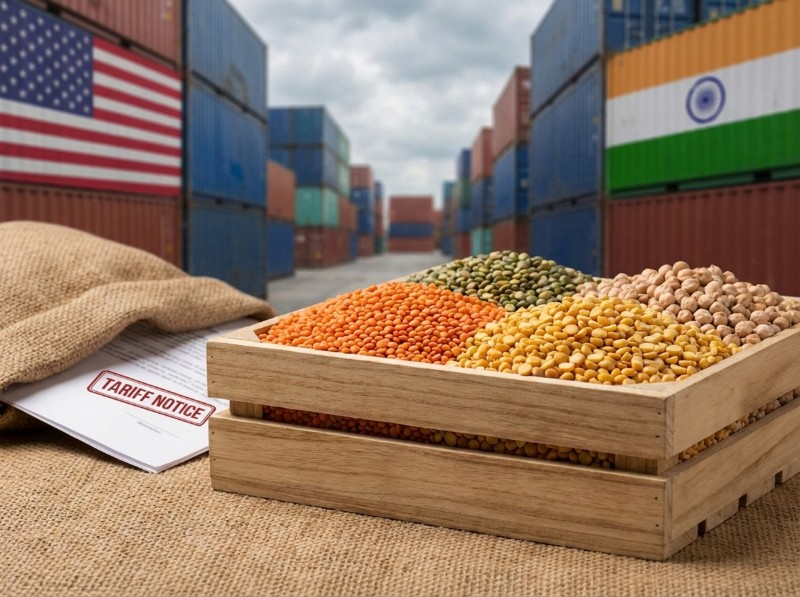
Two American lawmakers have written to President Donald Trump, urging him to press India to scrap its 30 percent import duty on US pulse crops.
The senators argue that American farmers are being placed at a “significant competitive disadvantage” due to what they describe as unfair trade practices by New Delhi.
The issue has surfaced at a sensitive moment, coming after the Trump administration imposed steep 50 percent tariffs on trade with India, a move that already strained bilateral economic ties.
What US lawmakers said
Republican Senators Steve Daines of Montana and Kevin Cramer of North Dakota authored the letter, pointing out that their states are the largest pulse producers in the United States.
They highlighted India’s position as the world’s biggest consumer of pulses, accounting for roughly 27 percent of global demand.
The senators noted that staples such as lentils, chickpeas, dried beans and peas form a significant part of the Indian diet, yet American exports in these categories face heavy import duties.
They referenced India’s decision last October to impose a 30 percent tariff on yellow peas, which took effect from November 1, 2025.
“As a result of the unfair Indian tariffs, US pulse crop producers face a significant competitive disadvantage when exporting their high-quality product to India,” the letter stated.
Call for Modi-Trump engagement
The lawmakers urged Trump to directly engage Prime Minister Narendra Modi on the issue, suggesting that easing pulse tariffs would be mutually beneficial.
They argued that lower duties could help American farmers access India’s vast consumer market while also offering Indian buyers more competitive pricing.
They also thanked Trump for his continued efforts to support agricultural producers in Montana and North Dakota.
As trade negotiations progress, the senators encouraged him to ensure favourable provisions for US pulse exporters in any future agreement with India.
Echoes of past trade talks
Daines and Cramer recalled raising the same issue during Trump’s first term, ahead of the 2020 trade negotiations with India.
They said the president had personally delivered their earlier letter to Prime Minister Modi, which helped bring American producers into trade discussions.
The senators reiterated their belief that American farmers have the capacity to help address global food needs if trade barriers are reduced.
They said US producers stand ready to “feed and fuel the world” if export opportunities expand.
Impact of GSP withdrawal
In their 2020 letter, the senators had also pointed to the impact of India’s removal from the US Generalised System of Preferences in June 2019.
Following the withdrawal, additional duties were imposed on American exports, further hurting pulse growers.
They argued that these policy shifts significantly damaged US pulse producers, especially in key farming states, and warned that continued tariff barriers could further derail trade momentum.
Growing complication for trade talks
With pulses now joining the list of unresolved trade issues, prospects for a smooth India-US agreement appear uncertain.
As both sides attempt to rebalance trade disparities, the outcome of Trump’s response to the senators’ appeal could shape the next phase of negotiations between the two strategic partners.
Support Our Journalism
We cannot do without you.. your contribution supports unbiased journalism
IBNS is not driven by any ism- not wokeism, not racism, not skewed secularism, not hyper right-wing or left liberal ideals, nor by any hardline religious beliefs or hyper nationalism. We want to serve you good old objective news, as they are. We do not judge or preach. We let people decide for themselves. We only try to present factual and well-sourced news.
Support objective journalism for a small contribution.