


 Aditya L1
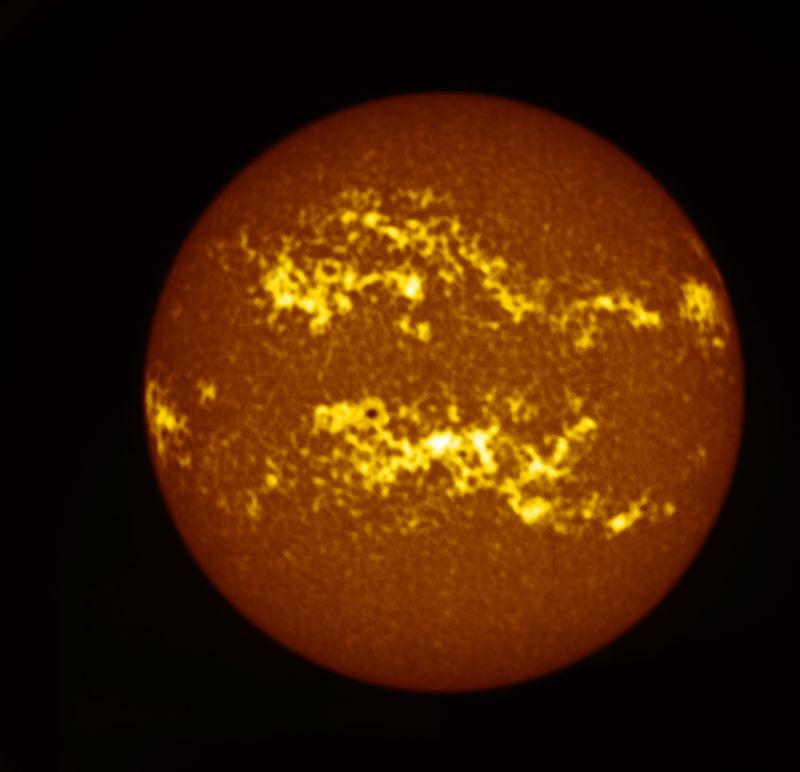
Aditya L1 captures images of Sun during solar fury, ISRO releases pictures of the celestial event
Two onboard remort sensing instruments preset in the Indian Space Research Organisation (ISRO)'s Aditya-L1 spacecraft have captured the recent solar fury.
In a statement, ISRO said: " The Active region AR13664 on the Sun, during its passage during the week of May 8 – 15, 2024, erupted several X-class and M-class flares, which were associated with Coronal Mass Ejections (CMEs) during May 8 and 9."
" These produced a major geomagnetic storm on May 11, 2024. Two of the remote sensing payloads on board Aditya-L1 (SoLEXS and HEL1OS) captured these events during May 8-9, 2024 while the two in-situ payloads (ASPEX and MAG) captured this event during May 10-11, 2024 during its passage through L1," ISRO said.
Aditya-L1 Mission:
— ISRO (@isro) June 10, 2024
SUIT and VELC instruments have captured the dynamic activities of the Sun 🌞 during May 2024.
Several X-class and M-class flares, associated with coronal mass ejections, leading to significant geomagnetic storms were recorded.
📷✨ and details:… pic.twitter.com/Tt6AcKvTtB
"These observations were subsequently reported by ISRO, along with the observations made by the Chandrayaan-2 spacecraft, XPoSat as well as by USO-PRL ground-based facility," ISRO said.
"During those series of eruptive events, two remote sensing instruments onboard Aditya-L1, viz. the Solar Ultra Violet Imaging Telescope (SUIT) and the Visible Emission Line Coronagraph (VELC) were in baking and calibration modes respectively, and couldn’t observe the event during May 10- 11. Both SUIT and VELC doors were opened on May 14 after the completion of the indented operations," the statement said.
Aditya L1 is the first space-based Indian mission to study the Sun.
The mission was launched on September 2, last year.
Support Our Journalism
We cannot do without you.. your contribution supports unbiased journalism
IBNS is not driven by any ism- not wokeism, not racism, not skewed secularism, not hyper right-wing or left liberal ideals, nor by any hardline religious beliefs or hyper nationalism. We want to serve you good old objective news, as they are. We do not judge or preach. We let people decide for themselves. We only try to present factual and well-sourced news.
Support objective journalism for a small contribution.


