‘Prevention crisis’ is hampering global HIV response, warns head of UNAIDS
New York, July 19 (IBNS): Complacency over HIV and AIDS has created a “prevention crisis” that risks destabilizing efforts to reach the key 2020 target of fewer than 500,000 new HIV infections per year, the head of the UN agency in charge of fighting the pandemic warned on Wednesday.
Describing his appeal as a “wake-up call” to the global community, UNAIDS Executive Director Michel Sidibé explained that “partial successes” in saving lives and stopping new infections - some 1.4 million since 2010 - had resulted in a lack of urgency among Member States.
This is despite the fact that 180,000 children became infected with HIV last year, missing the 2018 target of protecting all youngsters from the virus, Sidibé said.
The UNAIDS chief also noted that more than three decades into the HIV epidemic, three-in-five people starting HIV treatment are still not screened, tested or treated for tuberculosis - the biggest killer of people living with HIV.
Other successes include the fact that three out of four people living with HIV are now aware of their status – an important first step to getting medical help, the UNAIDS chief said.“The number of AIDS-related deaths is the lowest this century,” he said introducing the agency’s latest report, noting that fewer than one million people per year now die from illnesses linked to AIDS, which stands for Acquired Immunodeficiency Syndrome, caused by the Human Immunodeficiency Virus (HIV).
In addition, a record 21.7 million people are on treatment—an increase of 2.3 million people since the end of 2016, according to the Global AIDS Update 2018.
Despite these apparent successes, globally, new HIV infections have declined by only 18 per cent in the past seven years, UNAIDS says, from 2.2 million in 2010 to 1.8 million in 2017.
At its peak in 1996, 3.4 million people were infected by the virus.
The reduction in new HIV infections has been strongest in the region most affected by HIV, Eastern and Southern Africa, where new HIV infections have fallen by 30 per cent since 2010.
While these results are welcome, the UNAIDS Chief Executive cautioned that an additional 2.8 million people a year will require access to treatment for the next three years, if global targets are to be met.
And although there is an urgent need to do this, “there are no new commitments to increase resources, there is an acute shortage of health-care workers and there is continuing stigma and discrimination”, he said.
One key and immediate challenge is reducing new HIV infections which are not falling fast enough, Sidibé added, owing to a lack of impetus on prevention.
This is despite many available measures to protect vulnerable and marginalized communities who face an increased risk of HIV infection, the reason being that they are not being scaled up sufficiently and they “are not reaching the people who need them the most”.
And in a call for Governments everywhere to “protect everyone”, the UNAIDS chief noted the terrible consequences of stigma and discrimination, which lead to the denial of access to critical HIV services and result in more deaths.
“Human rights are universal,” he said. “Bad laws that criminalize HIV transmission, sex work, personal drug use and sexual orientation or hinder access to services must go, and go now.”
In terms of international funding to fight AIDS, resources increased last year, but there is still a 20 per cent shortfall.
A cut of this magnitude “will be catastrophic” for the 44 countries that rely on international assistance for the majority of their national AIDS policy response, said the UNAIDS chief.
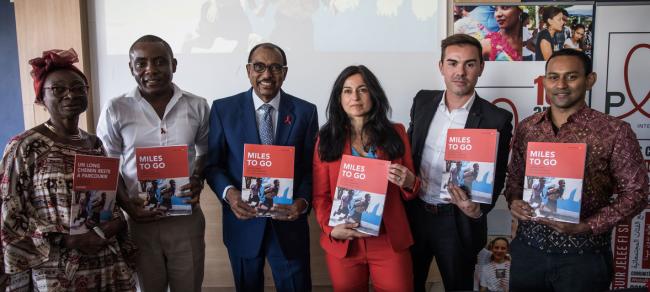
UNAIDS/Laurence Geai
Support Our Journalism
We cannot do without you.. your contribution supports unbiased journalism
IBNS is not driven by any ism- not wokeism, not racism, not skewed secularism, not hyper right-wing or left liberal ideals, nor by any hardline religious beliefs or hyper nationalism. We want to serve you good old objective news, as they are. We do not judge or preach. We let people decide for themselves. We only try to present factual and well-sourced news.
Support objective journalism for a small contribution.