


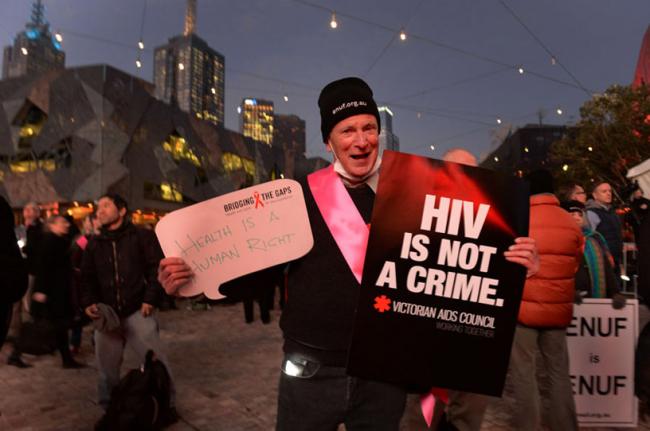
AIDS is a 'human rights issue,' Ban declares, launching major new UN report in Barbados
“A quarter of a million people in this region live with HIV. The governments here struggle to finance their responses,' said Mr. Ban at the launch in the region of study released today by the Joint UN Programme on HIV/AIDS (UNAIDS) and renowned medical journal, The Lancet.
The UN chief is in Barbados on an official visit in the context of the Caribbean Community (CARICOM) Summit, which he addressed last night.
The report, Defeating AIDS – Advancing Global Health was released in late June, and, among others warns that despite some advances in the battles against the disease, the rate of new HIV infections is not falling fast enough. As a result, the study calls for an urgent need to scale up AIDS efforts, calls on governments to ramp up HIV prevention efforts, and continue expanding access to treatment.
In his remarks today, Mr. Ban stressed that the epidemic is only made worse by punitive laws and stigma. These drive vulnerability to HIV infection – and block access to life-saving treatment.
“Homophobia threatens both human rights and public health. We cannot tolerate discrimination on the basis of sexual orientation, nor on the basis of gender identity. We must also defend the human rights of sex workers and of people who inject drugs,” he declared.
The Secretary-General said the report has four main messages. First, the world has the knowledge, tools and know-how to end the AIDS epidemic by 2030, and the Commission that compiled the study spells out how to achieve this.
“Second, we need to urgently increase and fully fund our AIDS response. Today the world invests $19 billion annually in addressing AIDS. To reach our targets, we need to almost double this amount,” he said, calling for a rapid scale-up – led by countries, with critical support from global and private partners – over the next five years so the world will be on track to end the epidemic by 2030.
Third, he urged applying lessons learned from the AIDS response to other complex challenges, stressing that young people, women, gay activists and campaigners for equality drive progress and that activism pushes boundaries–to ensure access to affordable medicines, political influence and justice.
“Fourth, we can leave no one behind. AIDS will only end when we protect the human rights of all. This disease thrives on unjust power relations and inequalities. We have to battle all forms of societal ills including stigma, intolerance, discrimination and violence,” underscored Mr. Ban.
Continuing, he said that ending the epidemic would demand the achievement of gender equality. “We need to protect sexual and reproductive rights. And we need to give adolescents life-skills, including education about their sexuality.”
“AIDS is about more than human health – it is fundamentally an issue of human rights,” the UN chief said.
Support Our Journalism
We cannot do without you.. your contribution supports unbiased journalism
IBNS is not driven by any ism- not wokeism, not racism, not skewed secularism, not hyper right-wing or left liberal ideals, nor by any hardline religious beliefs or hyper nationalism. We want to serve you good old objective news, as they are. We do not judge or preach. We let people decide for themselves. We only try to present factual and well-sourced news.
Support objective journalism for a small contribution.


