


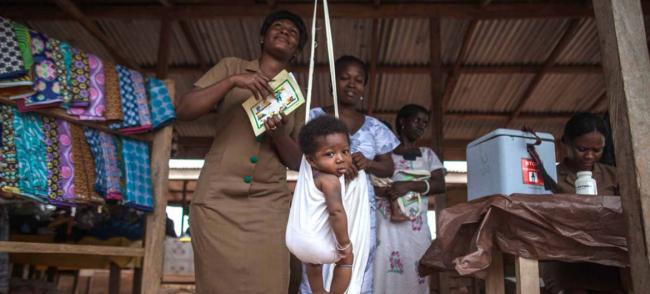
Better care, stronger laws needed to save 30 million babies on the brink of death
New York, Dec 14 (IBNS): Nearly 30 million babies each year - nearly a quarter of the total - are born too soon, too small or become sick, requiring specialized care to survive beyond the first month of life, according to a new report by a global coalition that includes the UN Children’s Fund (UNICEF) and World Health Organization (WHO).
“When it comes to babies and their mothers, the right care at the right time in the right place can make all the difference,” said Omar Abdi, UNICEF Deputy Executive Director. “Yet,” he continued, “millions of small and sick babies and women are dying every year because they simply do not receive the quality care that is their right, and our collective responsibility.”
The report, “Survive and Thrive: Transforming care for every small and sick newborn,” finds that babies with complications from being born premature, or suffering brain injury during childbirth, severe bacterial infection or jaundice, risk death and disability.
Furthermore, the financial and psychological toll on their families can effect their cognitive, linguistic and emotional development.
“For every mother and baby, a healthy start from pregnancy through childbirth and the first months after birth is essential,” said Dr. Soumya Swaminathan, Deputy Director General for Programmes at WHO, lauding universal health coverage to ensure that everyone, including newborns, has access to the health services they need, regardless of the ability to pay.
“Progress on newborn healthcare is a win-win situation: it saves lives and is critical for early child development thus impacting on families, society, and future generations,” she added.
The report revealed that some 2.5 million newborns died in 2017, mostly from preventable causes. Nearly two-thirds were premature. Should these babies survive, they often face chronic diseases or developmental delays. Figures disclose that an estimated one million small and sick newborns survive each year with a long-term disability.
A brighter tomorrow, with better strategies
The good news is that these babies can live without major complications if smarter strategies are employed, such as providing team care for both mother and baby through labour, birth and beyond, to catch problems and issues early. The report projects optimistically, that the lives of 2.9 million women, stillborns and newborns in 81 countries can be saved by 2030.
According to the report, for the world to achieve the global target of quality healthcare for all, newborn services must be transformed. Without rapid progress, some countries will not meet this target for another 11 decades.
Moreover, country policies should include quality health care and a lifelong investment for those born small or sick. Just 20 cents per person can save two of every three newborns in low- and middle-income countries by 2030.
The report spells out that it is time for all countries to put in place the legislative, medical, human and financial resources to ensure the highest standard of health care, guaranteed by the Convention on the Rights of the Child.
GAVI Alliance
Support Our Journalism
We cannot do without you.. your contribution supports unbiased journalism
IBNS is not driven by any ism- not wokeism, not racism, not skewed secularism, not hyper right-wing or left liberal ideals, nor by any hardline religious beliefs or hyper nationalism. We want to serve you good old objective news, as they are. We do not judge or preach. We let people decide for themselves. We only try to present factual and well-sourced news.
Support objective journalism for a small contribution.


