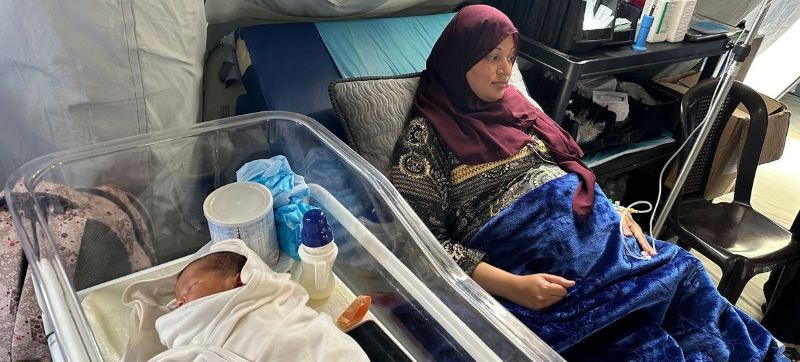
 Child Birth
Birth registration increases, but 150 million children still ‘invisible’, shows new UN study
A new report from the UN Children’s Fund (UNICEF) reveals significant progress in ending the problem of the “invisible” millions of babies each year who go unregistered. Nearly eight in 10 children under five were successfully registered at birth in the last five years.
However, the report, The Right Start in Life: Global Levels and Trends in Birth Registration, also highlights a troubling reality: 150 million children under five still go unregistered, meaning they don’t officially exist as far as government systems.
According to UNICEF Executive Director Catherine Russell, it is crucial that we provide “stronger efforts to ensure that every child, everywhere, is registered at birth.”
Birth registration is more than a legal formality - it is the gateway to rights and protections.
It ensures a child’s legal identity, prevents statelessness, and facilitates access to essential services like healthcare, education, and social protection.
Yet over 50 million children with registered births still lack birth certificates, a critical document for proving registration and securing nationality.
Regional disparities and challenges
While global birth registration rates have climbed from 75 per cent in 2019 to 77 per cent today, progress has been uneven.
Latin America and the Caribbean, Eastern and South-Eastern Asia, and Central and Southern Asia lead the way with less than 30 per cent of unregistered births.
Lagging is Sub-Saharan Africa home to half of the world’s unregistered children.
Within the region, the disparities are stark: Southern Africa reaches 88 per cent of registrations while Eastern and Middle Africa remain behind at just 41 per cent.
Rapid population growth in the region will exacerbate the challenge, with projections suggesting over 100 million unregistered children by 2030 if current trends persist.
Barriers to registration and solutions
Families face numerous barriers to registration. They often mention long distances and multiple visits to registration facilities, a lack of awareness about the process and discrimination based on gender, ethnicity, or religion. High costs also cause recurrent issues.
Nevertheless, countries like Botswana, Côte d’Ivoire, and Rwanda offer some hope, having achieved universal or near-universal registration through innovative approaches.
Their key strategies have included leveraging health and education systems, eliminating fees, and streamlining registration processes through digital technology.
Looking forward
In light of this new report, UNICEF calls for the establishment of birth registration as the foundation of a legal identity system.
The agency also plans to advocate for streamlined processes to enhance accessibility and using health, education, and social protection programmes to boost registration.
Legal reforms, through enacting inclusive laws to ensure equitable access and the empowering of communities to demand registration as a fundamental right are also crucial.
“Birth registration ensures children are immediately recognised under the law, providing a foundation for protection from harm and exploitation, as well as access to essential services like vaccines, healthcare, and education,” Russell noted, highlighting the crucial need to keep up efforts.
Support Our Journalism
We cannot do without you.. your contribution supports unbiased journalism
IBNS is not driven by any ism- not wokeism, not racism, not skewed secularism, not hyper right-wing or left liberal ideals, nor by any hardline religious beliefs or hyper nationalism. We want to serve you good old objective news, as they are. We do not judge or preach. We let people decide for themselves. We only try to present factual and well-sourced news.
Support objective journalism for a small contribution.