


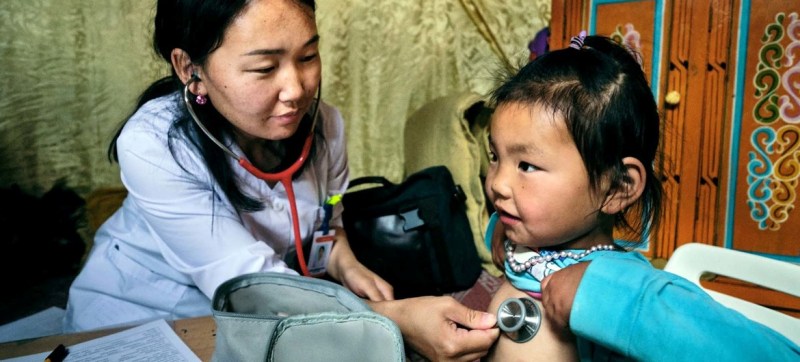
 Pneumonia
‘Bring life to those fighting for breath’, UNICEF urges on World Pneumonia Day
New York: Pneumonia is not a new emergency, it takes the lives of some 800,000 children each year, but this year’s COVID-19 pandemic makes it even more critical to stop the deadly infection, the UN Children’s Fund (UNICEF) warned on Thursday.
Marking World Pneumonia Day, on 12 November, UNICEF chief Henrietta Fore, highlighted the coronavirus factor, noting that “while the world grapples with the pandemic and the severe consequences it poses for the most vulnerable, we must not lose sight of the fact that pneumonia continues to claim more than 2,000 young lives every day.”
Every breath counts
UNICEF pointed out that medical oxygen, coupled with antibiotics, could save the lives of many children suffering with severe pneumonia.
However, cost can be prohibitive for the poorest families, as can access to health facilities with functioning oxygen supplies, and trained health workers – all of which are scarce in poorer countries.
Moreover, the pandemic has seen a surge in demand, making the shortages even more prominent.
Fortunately, oxygen can be produced locally in even remote parts of the world, at affordable cost. A key part of UNICEF COVID-19 response has been delivering oxygen concentrators, devices that take in air from the environment, remove nitrogen, and produce a continuous source of oxygen.
As of Wednesday, UNICEF had delivered 15,188 oxygen concentrators to 93 countries.
“Medical oxygen can help save some of these lives”, stressed Ms. Fore.
One size does not fit all
The response, however, is not a one-size-fits-all solution.
Some settings may have available oxygen plants, cylinder-delivery networks and reliable electricity sources to use a concentrator, while others may not.
And some areas face import restrictions for certain health supplies, or dwindling health budgets and rising prices set by oxygen suppliers.
To address this, UNICEF is working with governmentsand partners for unique country solutions, mostly involve a mix of oxygen sources from cylinders, concentrators, plants and liquid oxygen.
The UN agency’s response has been global, rapid, and multi-faceted as it has supplied medical oxygen to over 90 countries to help fight COVID-19 and keep children and newborns with pneumonia alive.
Oxygen is the answer
Although this complex commodity can be challenging to provide, especially in rural settings where electricity, infrastructure and essential health equipment may be in short supply, UNICEF has noted a shift in policy worldwide.
Over the past year, governments, donors, UN agencies and partners have begun to recognize the importance of this essential medicine in helping people recover from pneumonia, whether COVID-19-induced or not. UNICEF is calling on everyone, to “amplify efforts to bring life to those fighting for breath”.
Support Our Journalism
We cannot do without you.. your contribution supports unbiased journalism
IBNS is not driven by any ism- not wokeism, not racism, not skewed secularism, not hyper right-wing or left liberal ideals, nor by any hardline religious beliefs or hyper nationalism. We want to serve you good old objective news, as they are. We do not judge or preach. We let people decide for themselves. We only try to present factual and well-sourced news.
Support objective journalism for a small contribution.


