Canada: NASA-style Stopwatch measures pulse of laser light
ICESat-2, scheduled to launch in 2018, will use six green laser beams to measure height. Added to this feature was its accurate time management capacity which, the scientists felt, would enable them to calculate the distance between the satellite and Earth below. The scientists also said they would be able to record accurate height measurements of sea ice, glaciers, forests and the rest of the planet’s surfaces.
"Light moves really, really fast, and if you’re going to use it to measure something to a couple of centimeters, you’d better have a really, really good clock," said Tom Neumann, ICESat-2’s deputy project scientist.
But even though ICESat-2 could calculate time to millionth of a second, it could only measure height to within about 500 feet. Scientists wouldn’t be able to tell the top of a five-story building from the bottom. This fact, the researchers and the scientists felt, would not lead to their goal of measuring the height of the Earth’s surface from the satellite. They also would not be able to record the changes such as melting of ice sheets or thinning of sea ice.
The scientists needed to reach the precision of a fraction of a billionth of a second. This led Goddard engineers and researchers to build their own series of clocks on the satellite’s instrument, which they named the Advanced Topographic Laser Altimeter System, or ATLAS. The measurement of accurate time to a fraction of a billionth of a second with ATLAS, the researchers thought would allow them to measure heights to within about two inches.
"Calculating the elevation of the ice is all about time of flight," said Phil Luers, deputy instrument system engineer with the ATLAS instrument, CBCNews reports said.
Leurs explained that ATLAS sends beams of laser light to the ground and then records how long it takes each photon to return. This time, when combined with the speed of light, could tell researchers the distance laser light had traveled. This distance of the flight and the time taken to reach there could help researchers determine the height of Earth’s surface below.
"If you know where the spacecraft is, and you know the time of flight so you know the distance to the ground, now you have the elevation of the ice," Luers said, CBCNews reports said.
The time clock is also fitted with the GPS receiver, which ticks off every second. ATLAS is fitted with still another clock called an ultrastable oscillator which counts off every 10 nanoseconds within those GPS-derived seconds.
To get even more precise timing, engineers have outfitted a fine-scale clock within each photon-counting electronic card. This clock has the capacity to subdivide 10-nanosecond ticks even further, facilitating the measurement of the return time of the photons to the hundreds of picoseconds.
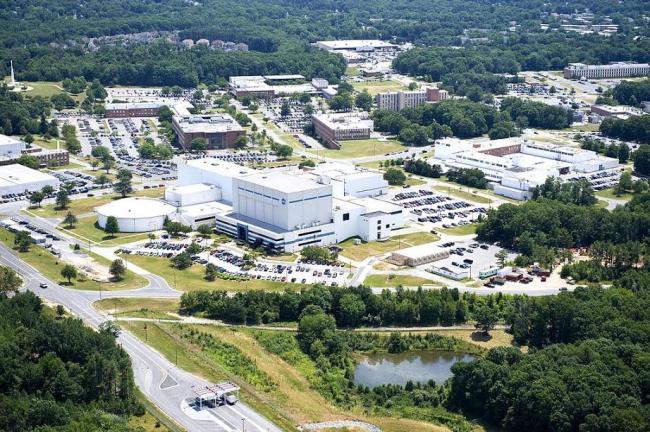
(Reporting by Asha Bajaj, Image of NASA’s Goddard Space Flight Center: Wikipedia)
Support Our Journalism
We cannot do without you.. your contribution supports unbiased journalism
IBNS is not driven by any ism- not wokeism, not racism, not skewed secularism, not hyper right-wing or left liberal ideals, nor by any hardline religious beliefs or hyper nationalism. We want to serve you good old objective news, as they are. We do not judge or preach. We let people decide for themselves. We only try to present factual and well-sourced news.
Support objective journalism for a small contribution.