Conjugate drug extends survival in patients with advanced HER2-positive breast cancer, trial shows
The results, reported online today by The Lancet Oncology, solidify the role of the combination drug, trastuzumab emtansine, in treating this group of patients, the study authors say.
The trial, known as the TH3RESA trial, enrolled 602 patients at 146 treatment centers in 22 countries. They were randomly assigned to be treated with either trastuzumab emtansine (T-DM1) or a treatment of their physician’s choice.
All had advanced breast cancer that tested positive for the human epidermal growth factor receptor 2 (HER2) protein – a feature of about 20 percent of all breast cancers – and was progressing even after treatment with chemotherapy and the HER2-targeting drugs trastuzumab and lapatinib.
The investigators found that those in the trastuzumab emtansine group lived a median of 22.7 months vs. 15.8 months for those in the physician’s choice group – a 44 percent improvement. (The treatment of physician’s choice consisted of HER2-targeted therapy with either single-drug chemotherapy or hormonal therapy, or any of these drugs alone.)
The survival benefit associated with trastuzumab emtansine was consistent across all patient subgroups, regardless of age, degree of metastasis, number of prior treatments, and type of treatment of physician’s choice.
The incidence of severe side effects deemed severe or greater was lower in the trastuzumab emtansine group – 40 percent, compared to 47 percent for those in the treatment of physician’s choice group.
Trastuzumab emtansine combines trastuzumab, an antibody that latches onto the HER2 protein and blocks it from receiving growth signals, and emtansine, a potent chemotherapy drug that disrupts the way cells grow. By attaching the two agents together, the drug delivers emtansine directly to the HER2-positive cancer cells. This essentially makes emtansine into a targeted drug that is highly effective at killing HER2-positive cancer cells, but largely avoids damaging normal cells.
“This is an important trial because it demonstrates that even in patients whose cancer has progressed on multiple other HER2-targeted therapies, treatment with trastuzumab emtansine substantially extends patient survival compared to other drugs,” said the Lancet paper’s first author, Ian Krop, MD, PhD, senior physician in the Susan F. Smith Center for Women’s Cancers at Dana-Farber. “Based on this study and others, trastuzumab emtansine should be considered the standard of care for patients whose cancer has progressed with HER2-targeted therapy.”
The results of the trial are confirmed in a companion study in The Lancet Oncology led by researchers in France and Italy with Krop as a co-author.
That study reports the results of the phase 3 EMILIA study, which compared trastuzumab emtansine to the chemotherapy agent capecitabine and targeted drug lapatinib in patients with previously treated advanced HER2-positive breast cancer. As in the TH3RESA study, patients treated with trastuzumab emtansine had improved overall survival compared to those receiving the other treatment.
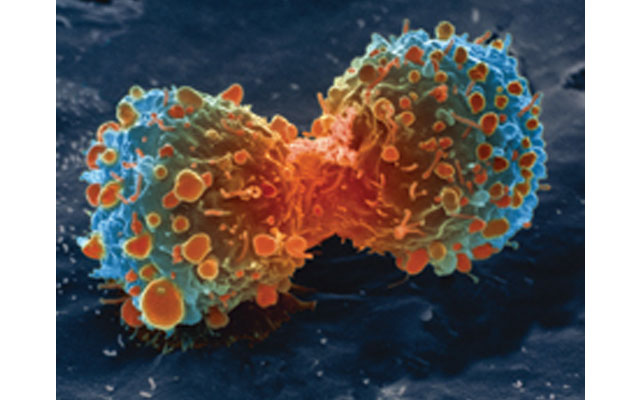
Image: Wikimedia Commons
Support Our Journalism
We cannot do without you.. your contribution supports unbiased journalism
IBNS is not driven by any ism- not wokeism, not racism, not skewed secularism, not hyper right-wing or left liberal ideals, nor by any hardline religious beliefs or hyper nationalism. We want to serve you good old objective news, as they are. We do not judge or preach. We let people decide for themselves. We only try to present factual and well-sourced news.
Support objective journalism for a small contribution.