 Square Kilometre Array
Construction to begin on world's biggest telescope
London/UNI: One of the grand scientific projects of the 21st century began its construction phase on Monday.
The Square Kilometre Array (SKA) will be the largest radio telescope in the world when completed in 2028, BBC reported.
Split across South Africa and Australia, with a headquarters in the UK, the facility will address the biggest questions in astrophysics.
It will perform the most precise tests of Einstein's theories, and even search for extraterrestrials.
Delegations from the eight countries leading the project are attending ceremonies in the remote Murchison shire in Western Australia and in the Karoo of South Africa's Northern Cape, the BBC reported.
When the festivities are over, the bulldozers will move in.
"This is the moment it becomes real," said Prof Phil Diamond, director general of the Square Kilometre Array Organisation.
"It's been a 30-year journey. The first 10 years were about developing the concepts and ideas. The second 10 was spent doing the technology development.
"And then the last decade was about detailed design, securing the sites, getting governments to agree to set up a treaty organisation (SKAO) and provide the funds to start," he told BBC News.
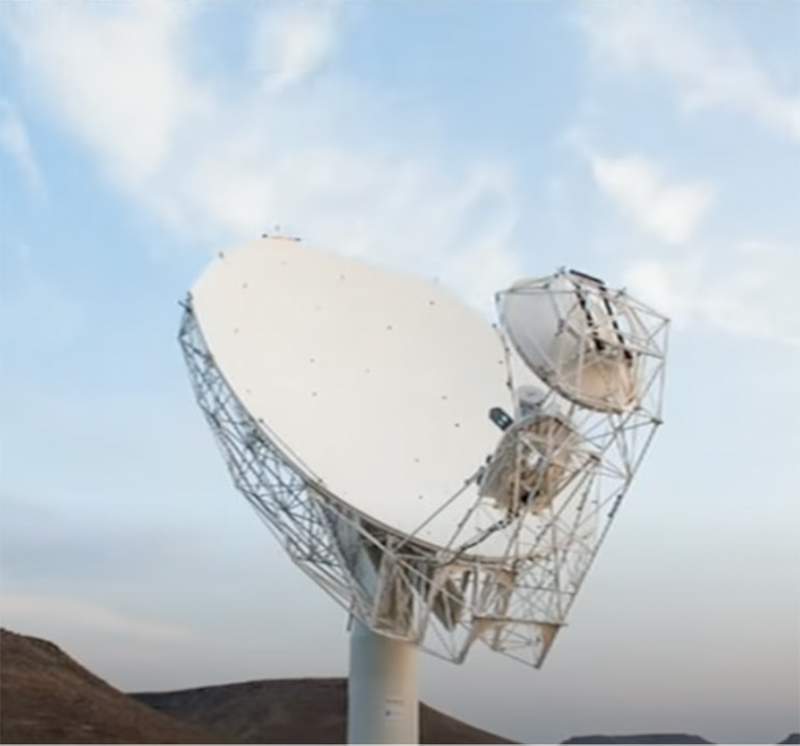
The initial architecture of the telescope will incorporate just under 200 parabolic antennas, or "dishes", as well as 1,31,000 dipole antennas, which look a little like Christmas trees.
The aim is to construct an effective collecting area measuring hundreds of thousands of square metres.
This will give the SKA unparalleled sensitivity and resolutions as it probes targets on the sky.
The system will operate across a frequency range from roughly 50 megahertz to, ultimately, 25 gigahertz.
In wavelength terms, this is in the centimetres to metres range.
This should enable the telescope to detect very faint radio signals coming from cosmic sources billions of light-years from Earth, including those signals emitted in the first few hundred million years after the Big Bang.
Support Our Journalism
We cannot do without you.. your contribution supports unbiased journalism
IBNS is not driven by any ism- not wokeism, not racism, not skewed secularism, not hyper right-wing or left liberal ideals, nor by any hardline religious beliefs or hyper nationalism. We want to serve you good old objective news, as they are. We do not judge or preach. We let people decide for themselves. We only try to present factual and well-sourced news.
Support objective journalism for a small contribution.