


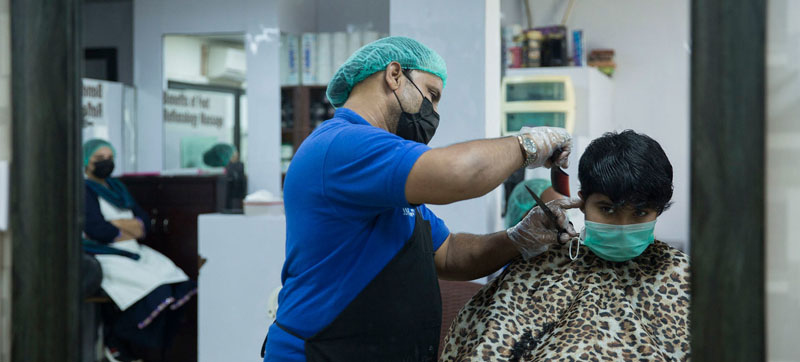
 COVID19 Cases Rising
COVID-19 cases rise for first time in seven weeks: WHO
New York: After six consecutive weeks of decline, COVID-19 cases worldwide increased last week for the first time, the World Health Organization (WHO) said on Monday.
Four of the agency’s six regions reported a rise in numbers, with Africa and the Western Pacific excluded.
“This is disappointing, but not surprising”, said WHO chief Tedros Adhanom Ghebreyesus, speaking during his biweekly press briefing from Geneva.
“Some of it appears to be due to relaxing of public health measures, continued circulation of variants, and people letting down their guard.”
The jump in cases comes as the rollout of COVID-19 vaccines continues.
“Vaccines will help to save lives, but if countries rely solely on vaccines, they’re making a mistake”, Tedros warned, underscoring the importance of basic public health measures such as testing, contact tracing, wearing masks and avoiding crowds.
‘Encouraging’ signs
Ghana and Côte d’Ivoire began vaccinating health care workers on Monday, becoming the first countries to benefit from a global mechanism for ensuring vaccine equity.
Through the COVAX Facility, WHO and our partners are working to ensure every country can begin vaccination within the first 100 days of the year.
COVAX will deliver 11 million doses to countries this week. By the end of May, some 240 million doses will be allocated to 142 participating countries.
Dr. Soumya Swaminathan, WHO’s Chief Scientist, pointed to “encouraging” signs as the world continues to gear up for what is the largest vaccine deployment in history.
“We’ve seen early data from countries where vaccination campaigns started months ago, the impact that this is having on reducing hospitalizations, reducing deaths, particularly in the older age groups, amongst the vulnerable. We’ve even seen very encouraging data in reduction in infections among health care workers who have received the vaccine”, she said.
“So, these are still early days, but the signs are encouraging; the safety profile is encouraging. About 250 million doses have been given worldwide, and so far, there have been no major safety signals, so that is reassuring as well.”
Concern for Tigray region
WHO explained that some countries have received COVAX vaccines early due to several factors such as the level of government preparedness, but logistical challenges in distributing vaccines, which include labelling, packaging and shipping, can also affect deployment.
He said the situation is of grave concern, as water, sanitation, essential health services and COVID-19 intervention have been disrupted. Many people are living in displacement camps, increasing risk of diarrhoeal disease, malaria and other illneses. Dr. Michael Ryan, WHO Executive Director, spoke about the difficulty in reaching conflict areas such as the Tigray region in Ethiopia, where government and regional forces have been fighting since November.
WHO has worked to provide essential supplies to cover 450,000 people, or roughly 10 per cent of the population, for three months, Dr. Ryan told journalists.
“Our primary aim as an organization, wherever we work, is to ensure that all people have access to the basic, essential human right of access to basic health care”, he said.
“We will work with the Ministry of Health; we will work with health cluster partners and anybody else who can help us to provide better access to the population there.”
Support Our Journalism
We cannot do without you.. your contribution supports unbiased journalism
IBNS is not driven by any ism- not wokeism, not racism, not skewed secularism, not hyper right-wing or left liberal ideals, nor by any hardline religious beliefs or hyper nationalism. We want to serve you good old objective news, as they are. We do not judge or preach. We let people decide for themselves. We only try to present factual and well-sourced news.
Support objective journalism for a small contribution.


