


Deadly life at sea: UN partners spotlight depths of danger in fishing industry
New York/IBNS: There is a clear link between the seedy underbelly of the seafood industry, and fishers’ safety, now ranked as the second deadliest profession in the world; and more must be done to ensure people dependent on this type of labour are working in safe conditions, UN partners urged on Thursday.
“Every hour fishers die doing their job - not just men, women too”, Maria Helena Samedo, chief for Climate and Natural Resources at the Food and Agriculture Organization (FAO), explained at a major conference organized by the agency in Rome, coinciding with World Fisheries Day on 21 November.
“Human rights violations and unacceptable practices at different stages of the value chain are increasing in fisheries and aquaculture”, she added.
Illegal, Unreported and Unregulated (IUU) fishing leads to over-exploitation of fish stocks, already drained by pollution and climate impacts, and financially burdens honest fishers and the communities that depend on them, FAO and the International Labour Organisation (ILO) said in a joint statement at the conclusion of the International Symposium on Fisheries Sustainability.
A lucrative catch
Beyond injuring biodiversity and economies, IUU casts a dark shadow on already physically-taxing sea labour, with many IUU fishers engaging in transnational crimes, such as human and drug trafficking and piracy.
Around the world, one in ten people depend on fishing to make a living and feed their families, and often, they are some of the poorest in society, according to FAO.
An estimated 95 per cent of those relying on the seafood business to provide for their families, live in Africa and Asia, often enduring gruesome working conditions. In 2019, fishing was ranked and the second most dangerous job in the world, just behind logging.
Vulnerable youth and migrants often find casual jobs aboard vessels with working and living conditions well below acceptable standards.
Crewmembers are notoriously denied previously agreed wages, if they get paid at all, while some captains and boat owners ignore basic human rights, forcing fishers to endure extended periods at sea, under dangerous conditions.
Transnational fishing operations entangled with organized crimes pose additional challenges for law enforcement; with frequent border crossing, fishers reporting to criminal captains therefore have little or no protection, ILO reports.
FAO has been working alongside governmental and international partners to tackle the scourge of IUU, a lucrative industry valued at an estimated $10 to $23 billion every year.
Fishing for SDGs
Speaking at the Symposium’s conclusion in Rome, Monsignor Bruno Marie Duffé, Secretary of the Vatican’s Dicastery for Promoting Integral Human Development, noted that Pope Francis has spoken of the need for a more integral approach to ecology, and the Holy See has called for greater synergy between governments and maritime authorities to protect human rights in this sector.
FAO has developed a number of international instruments designed to promote dialogue and policy processes to achieve sustainable fisheries management, in line with UN Sustainable Development targets.
By the Symposium’s end, participants are expected to present a technical document that synthesized the information and debate in each of the event’s sessions, to be table at the 34th session of the FAO Committee on Fisheries, set for July 2020.
The document will form the platform for a high-level policy statement on the role, value and sustainability status of global and regional fisheries.
Photo caption and credit:
UN Photo/Martine Perret
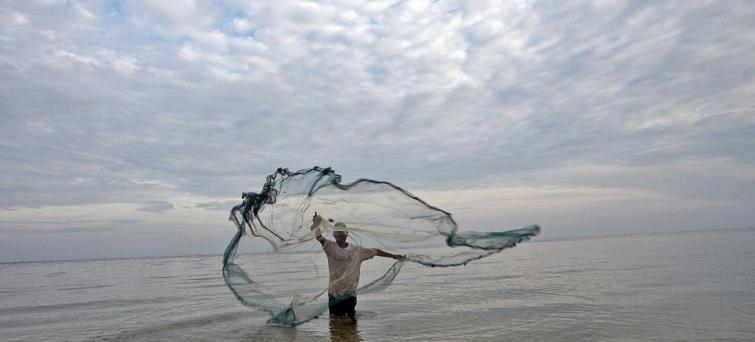
Fisherman in Timor Leste casts net in the water to catch small fish. UN Photo/Martine Perret
Support Our Journalism
We cannot do without you.. your contribution supports unbiased journalism
IBNS is not driven by any ism- not wokeism, not racism, not skewed secularism, not hyper right-wing or left liberal ideals, nor by any hardline religious beliefs or hyper nationalism. We want to serve you good old objective news, as they are. We do not judge or preach. We let people decide for themselves. We only try to present factual and well-sourced news.
Support objective journalism for a small contribution.


