


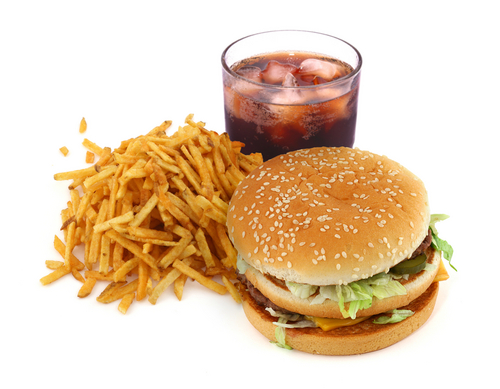
Delayed gratification associated with fast food frequency
The study, which appears early online in Preventive Medicine has public health significance since away-from-home eating, and fast food consumption in particular, contribute to obesity in the United States.
Food consumed away from home often consists of energy-dense nutrient-poor food, which increases the risk for obesity and other chronic conditions.
Behavioral economics, the application of psychology to economics, has the potential to offer additional insights into eating behaviors.
For example, previous research has shown “impatient time preferences” lead to decision-making based on immediate gratification (e.g. watching TV) instead of behavior (e.g. exercise) that will benefit one’s future welfare (e.g. improved longevity).
To investigate further, researchers from the American Cancer Society along with colleagues at the University of California, Irvine, University of Massachusetts, Amherst, and the Gretchen Swanson Center for Nutrition, embarked on this study to identify factors that affect away-from-home eating.
The study team analyzed responses from 5,871 U.S. adults taking part in a 2011 survey asking about lifestyle behaviors, including frequency of fast food consumption.
Also included were questions measuring time preferences. Participants were asked whether they preferred an immediate dollar amount now or a larger sum later (e.g. $10 now or $12, $15, or $18 in 30 days).
The findings showed that willingness to wait for the larger amount was significantly associated with less frequent fast food intake.
Those who most often chose the delayed sum were 26% less likely to consume fast food than those on the other end of the scale.
There was no association with full-service restaurant intake.
The authors note that the results stem from cross-sectional data, limiting the ability to reach a conclusive determination about causality. Therefore, future longitudinal research on this topic is warranted.
“Our findings reveal that a high degree of future orientation appears to be protective against eating frequently at fast food establishments,” said Kerem Shuval, PhD, of the American Cancer Society, lead author of the study. “It may be possible, and relevant, to assess and inform individuals of their tendency to delay, or not delay, immediate gratification, and find strategies to prevent unhealthy behaviors. For example, packing lunches and healthful snacks in the evening to bring to work could potentially prevent trips to the vending machine or the adjacent fast food establishment.”
Michal Stoklosa, MA, senior economist at the American Cancer Society and a co-author on the study, added that another strategy suggested by behavioral economists is the use of pre-commitment contracts.
These are self-imposed present day constraints aimed at improving behavior in the future.
For example, a sum of money is deposited by the individual to a third party, and if pre-determined goals are not met, such as eating less frequently at fast food restaurants, the money will be lost or given to charity.
Additional study authors include: Jeffrey Drope, PhD (American Cancer Society), Matthew Harding, PhD (University of California, Irvine), Mark Pachucki, PhD (University of Massachusetts, Amherst), and Amy Yaroch, PhD (The Gretchen Swanson Center for Nutrition).
Image: Wikipedia Commons
Support Our Journalism
We cannot do without you.. your contribution supports unbiased journalism
IBNS is not driven by any ism- not wokeism, not racism, not skewed secularism, not hyper right-wing or left liberal ideals, nor by any hardline religious beliefs or hyper nationalism. We want to serve you good old objective news, as they are. We do not judge or preach. We let people decide for themselves. We only try to present factual and well-sourced news.
Support objective journalism for a small contribution.


