


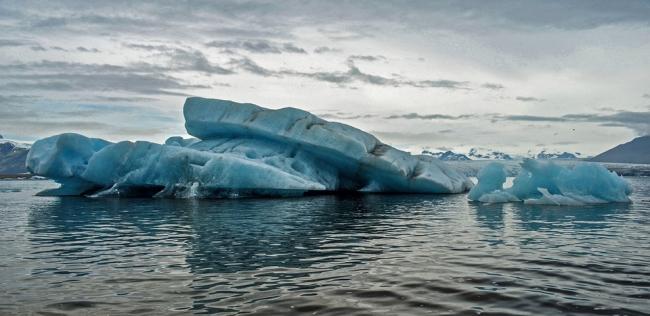
Earth at risk of entering a hothouse climate: Study
Sydney, Aug 11(IBNS): An international study has found the Earth is at risk of entering a hothouse climate that could lead to global average temperatures of up to five degrees Celsius higher than pre-industrial temperatures and long-term rises in the sea level of between 10 and 60 metres.
Lead researcher Professor Will Steffen from ANU said such increases in temperatures and sea level would be devastating for human civilisation and most ecosystems that support plant and animal life.
"The current efforts by nations, which are not sufficient to meet the emission-reduction targets set in the Paris Agreement a few years ago, are unlikely to help us avoid this very risky situation, where many parts of the planet could become uninhabitable for humans," said Professor Steffen from the ANU Fenner School of Environment and Society.
Global average temperatures are just over one degree Celsius above pre-industrial temperatures and rising at 0.17 degrees Celsius each decade.
"Human emissions of greenhouse gas are not the sole cause of temperature changes on Earth.
"Our study indicates that human-caused global warming of two degrees Celsius may trigger other Earth System processes, often called feedbacks, that can trigger further warming - even if we stop emitting greenhouse gases."
Professor Steffen said nations needed to work together to greatly accelerate the transition towards an emission-free world economy.
Researchers from Australia, Sweden, Denmark, the United Kingdom, Belgium, the United States, Germany and the Netherlands contributed to this study, which is published in the prestigious international journal PNAS.
The authors of the study considered 10 natural feedback processes, some of which are tipping elements that lead to abrupt change if a critical threshold is crossed.
"The real concern is these tipping elements can act like a row of dominoes. Once one is pushed over, it pushes Earth towards another. It may be very difficult or impossible to stop the whole row of dominoes from tumbling over," Professor Steffen said.
Such a feedback cascade could trigger the uncontrollable release into the atmosphere of carbon that had been previously stored in the Earth.
The feedbacks are permafrost thaw, loss of methane hydrates from the ocean floor, weakening land and ocean carbon sinks, increasing bacterial respiration in the oceans, Amazon rainforest dieback, boreal forest dieback, reduction of northern hemisphere snow cover, loss of Arctic summer sea ice, and reduction of Antarctic sea ice and polar ice sheets.
Support Our Journalism
We cannot do without you.. your contribution supports unbiased journalism
IBNS is not driven by any ism- not wokeism, not racism, not skewed secularism, not hyper right-wing or left liberal ideals, nor by any hardline religious beliefs or hyper nationalism. We want to serve you good old objective news, as they are. We do not judge or preach. We let people decide for themselves. We only try to present factual and well-sourced news.
Support objective journalism for a small contribution.


