


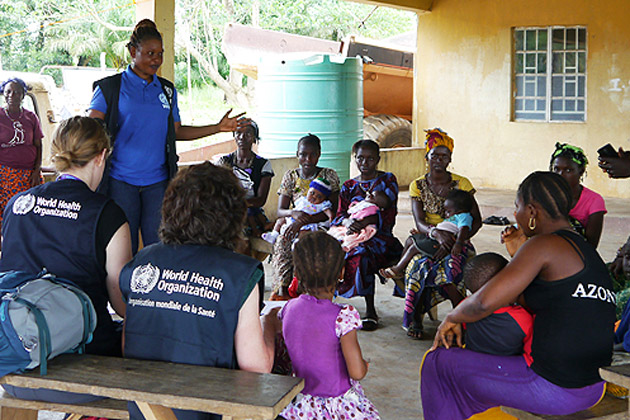
Ebola aftermath is 'best chance' to transform future epidemic response - UN health agency
WHO Director-General Dr. Margaret Chan, said however, that “the aftermath of the Ebola outbreak likely represents our best chance ever to transform the world’s response to epidemics and other health emergencies.”
Dr. Chan made those remarks in Geneva, Switzerland, at the beginning of a two-day meeting of the Review Committee on the Role of International Health Regulations in the Ebola Outbreak and Response, consisting of experts with a broad mix of scientific expertise and practical experience in public health, security, law and trade.
The review takes place at a time of nearly universal agreement that the international response to the Ebola outbreak in West Africa was inadequate. “When the number of cases in Guinea, Liberia, and Sierra Leone began to increase exponentially, all responders, including WHO, were overwhelmed,” she said.
Stating managing the global regime for controlling the international spread of disease is a central and historical responsibility of the WHO, Dr. Chan said “our challenge now is to look for improvements that leave the world better prepared for the next inevitable outbreak.”
“Your job is not an easy one,” she told the Committee. “Emerging and re-emerging infectious diseases have become a much larger menace under the unique conditions of the 21st century, with its unprecedented volume and speed of international travel and the radically increased interdependence among nations.”
Every day, nearly 100,000 flights carry 8.6 million passengers and $17.5 billion of goods to their destinations, she noted.
Also stating that Ebola in West Africa, where the epidemic has killed more than 11,000 people, was the largest, longest, and most deadly event in the nearly four-decade history of this disease, the top UN health officials said “it was not a worst-case scenario.”
“Preparedness for the future means preparedness for a very severe disease that spreads via the airborne route or can be transmitted during the incubation period, before an infected person shows tell-tale signs of illness,” she said.
At the 68th World Health Assembly in May 2015, member States set a mandate for a Review Committee on response to the Ebola outbreak. The Committee will recommend steps to improve the functioning, transparency, effectiveness and efficiency of the Regulations, and to strengthen preparedness and response for future emergencies with health consequences.
WHO/M. Harris
Support Our Journalism
We cannot do without you.. your contribution supports unbiased journalism
IBNS is not driven by any ism- not wokeism, not racism, not skewed secularism, not hyper right-wing or left liberal ideals, nor by any hardline religious beliefs or hyper nationalism. We want to serve you good old objective news, as they are. We do not judge or preach. We let people decide for themselves. We only try to present factual and well-sourced news.
Support objective journalism for a small contribution.


