


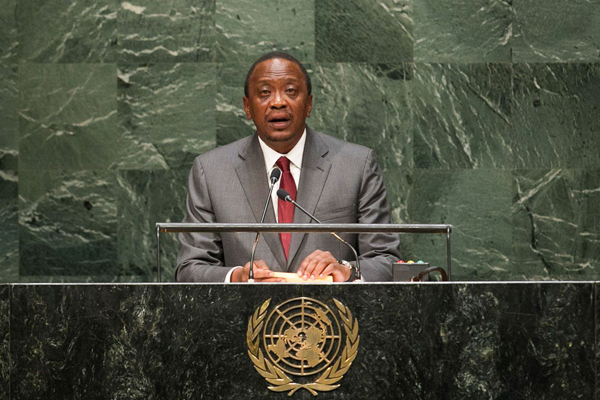
Ebola crisis highlights need for strong resourceful states, Kenyan leader tells UN assembly
“State weakness in many African countries comes from a history of development paradigms and practices that weakened the state,” he declared. “We must commit to build strong, resilient and accountable states that can effectively respond to shocks, adversities and emergencies in the future.”
He stressed the importance of this year’s session as it will oversee the development and adoption of the Post-2015 Development Agenda which is to set the path of global sustainable development for decades to come. “The new world development agenda must address itself to the entire cross-section of social, economic and environmental challenges that face the world in the 21st century,” he said.
“Issues of sustained economic development, equality between nations, climate change, industrialization, biodiversity loss and environmental protection, must now go hand in glove with the traditional challenges of poverty, disease, hunger and inequality within nations,” he added.
“We cannot speak of development or of transformation when millions of the world's people are mired in and are broken by unrelenting poverty, disease and hunger.”
Kenyatta stressed that terrorism and violent extremism stand in the way of achieving the new agenda. With strife-torn Somalia on Kenya’s northern border, “we stand at a critical moment,” he said. “As we deepen our democracy, we find our nation thrust into the frontline of a regional and global war against terror.”
Turning to Kenya’s own development, he cited “foundational changes” over the past four years, including universal immunization coverage, promotion of breast-feeding for the first six months of a child's life; provision of fortified foods and insecticide-treated mosquito nets; and free maternal and childcare in government hospital.
President Uhuru Kenyatta of Kenya addresses the General Assembly. UN Photo/Cia Pak
Support Our Journalism
We cannot do without you.. your contribution supports unbiased journalism
IBNS is not driven by any ism- not wokeism, not racism, not skewed secularism, not hyper right-wing or left liberal ideals, nor by any hardline religious beliefs or hyper nationalism. We want to serve you good old objective news, as they are. We do not judge or preach. We let people decide for themselves. We only try to present factual and well-sourced news.
Support objective journalism for a small contribution.


