


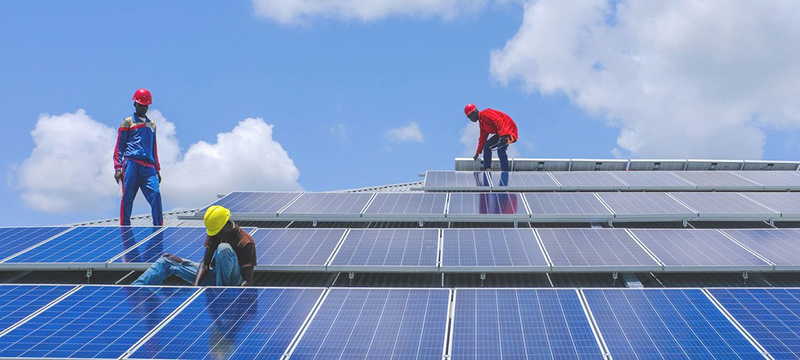
 Green Tech Revolution
Embrace green tech revolution or risk falling behind, new UN report warns
New York: Many developing countries may miss out on the benefits of the “green tech” revolution unless governments and the international community take decisive action now, the head of the UN Conference on Trade and Development (UNCTAD) said on Thursday, releasing its latest report.
“We are at the beginning of a technological revolution based on green technologies,” UNCTAD Secretary-General Rebeca Grynspan said. “This new wave of technological change will have a formidable impact on the global economy.”
The 17 frontier technologies covered in UNCTAD’s Technology and Innovation Report 2023 have the potential to create market revenues of more than $9.5 trillion by 2030, about three times the size of India’s economy today.
Coherent action
Used to produce goods and services with smaller carbon footprints, the new wave of green technologies spans artificial intelligence to electric vehicles.
The report calls for coherent policy action to enable developing countries to profit from green tech or risk facing growing economic inequalities, as developed countries reap most of the benefits.
“Developing countries must capture more of the value being created in this technological revolution to grow their economies,” Ms. Grynspan said. “Missing this technological wave because of insufficient policy attention or lack of targeted investment in building capacities would have long-lasting negative implications.”
Early adopters advance faster
While green tech exports from developing nations rose to $75 billion from $57 billion between 2018 and 2021, their share of the global market fell to 33 per cent from 48 per cent. During the same period, green exports from developed countries jumped to $156 billion from $60 billion.
UNCTAD’s analysis shows that developing countries must act quickly and move to a development trajectory leading to more diversified, productive, and competitive economies. Previous technological revolutions have shown that early adopters can move ahead quicker and create lasting advantages.
Wanted: agency and urgency
Proactive industrial, innovation, and energy policies targeting green technologies are needed in developing countries so they can benefit from the green tech revolution, said Shamika N. Sirimanne, director of UNCTAD's technology and logistics division.
“Developing countries need agency and urgency in coming up with the right policy responses,” she said. “As developing countries respond to today’s urgent interconnected crises, they also need to take strategic, long-term action to build innovation and technological capacities to spur sustainable economic growth and increase their resilience to future crises.”
UNCTAD calls on governments in developing countries to align environmental, science, technology, innovation, and industrial policies, and urges them to prioritize investment in greener and more complex sectors and provide incentives to shift consumer demand towards greener goods.
The report also calls for an international programme to guarantee purchases of tradable green items, coordinated green technology research at the multinational level, increased support for regional centres of excellence for green technologies and innovation, and a multilateral fund to stimulate green innovations and enhance cooperation between countries.
‘Least ready’ countries
The report’s “frontier technology readiness index” shows that very few developing countries have the capacities needed to profit from such green tech as blockchain, drones, gene editing, nanotechnology, and solar power.
Ranking 166 countries based on ICT, skills, research and development, industrial capacity, and finance indicators, the index is dominated by such high-income economies as the Netherlands, Singapore, Sweden and the United States. It also shows that countries in Latin America, the Caribbean and sub-Saharan Africa are the least ready to harness frontier technologies and are at risk of missing current technological opportunities.
Support Our Journalism
We cannot do without you.. your contribution supports unbiased journalism
IBNS is not driven by any ism- not wokeism, not racism, not skewed secularism, not hyper right-wing or left liberal ideals, nor by any hardline religious beliefs or hyper nationalism. We want to serve you good old objective news, as they are. We do not judge or preach. We let people decide for themselves. We only try to present factual and well-sourced news.
Support objective journalism for a small contribution.


