First-ever indigenous peoples' world conference concludes with focus on climate
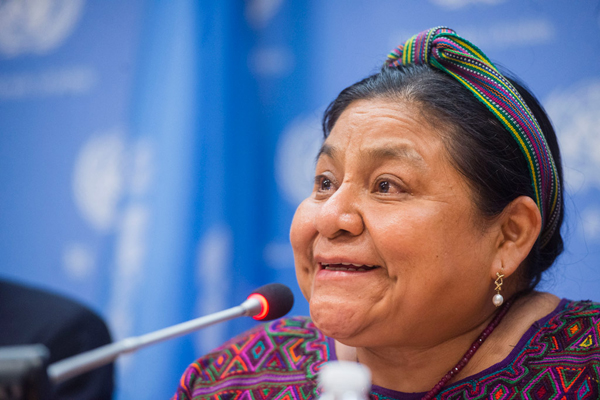
“Issues related to territory, our natural resources, territories, seas, rivers, are on Tuesday like the soul of indigenous rights,” Nobel Peace Prize winner Rigoberta Menchú told UNTV and UN Radio.
Menchú, an indigenous Guatemalan activist, said that for indigenous peoples this week’s events are a sign of hope towards a “full life and not just survival.”
Convened as the first high-level plenary meeting of the General Assembly’s 69th session, the two-day World Conference brought together over a thousand indigenous and non-indigenous delegates to discuss the realization of their rights, including pursuing the objectives of the UN Declaration on the Rights of Indigenous Peoples, adopted in 2007.
The Conference yesterday approved an Outcome Document strengthening the rights for more than 370 million indigenous people worldwide.
“We have set an important precedent with regard to our rights. The dream is that it will allow us to have a prosperous life for all the peoples benefited by this day,” Menchú said.
Addressing the closing session on Tuesday , the President of the General Assembly, Sam Kutesa, called the Outcome Document “a balance” between the collective, inclusive action of the indigenous people and an agreement from the Member States.
“I am convinced that its action-oriented provisions, when implemented, will bring about sweeping changes for current and future generations of indigenous peoples,” Kutesa said, urging representatives to “do your part to keep the momentum of our discussions moving forward.”
The Outcome Document also focuses on the rights of indigenous women and addressed the problem of violence against women, which he said “must be at the top of the agenda.”
He noted also references in the text to youth and the challenges they face, from the difficulty in sustaining indigenous languages to preserving traditional knowledge and ensuring sustainable livelihoods.
Also on Tuesday , the International Fund for Agricultural Development (IFAD) called for greater support to the economic and social empowerment of indigenous peoples.
While indigenous people account for five per cent of the world’s population, they make up 15 per cent of those living in poverty.
“Unless we mainstream the rights of indigenous peoples, unless we are serious about their empowerment, unless we work with them as equal partners – then any global development agenda we conceive will be a hollow exercise, empty because it will not reach the most disadvantaged,” said IFAD President Kanayo Nwanze.
The second day of the World Conference is being held in parallel with Secretary-General Ban Ki-moon’sClimate Summit. More than 120 Heads of States and Government, business, finance and civil society representatives are participating in the one-day event which aims to raise ambition, mobilize resources, and generate action towards a universal climate deal next year in Paris.
Nobel Peace Prize winner Rigoberta Menchú. UN Photo/Amanda Voisard
Support Our Journalism
We cannot do without you.. your contribution supports unbiased journalism
IBNS is not driven by any ism- not wokeism, not racism, not skewed secularism, not hyper right-wing or left liberal ideals, nor by any hardline religious beliefs or hyper nationalism. We want to serve you good old objective news, as they are. We do not judge or preach. We let people decide for themselves. We only try to present factual and well-sourced news.
Support objective journalism for a small contribution.