


 Vaccines
Global disparity in access to essential vaccines, says WHO report
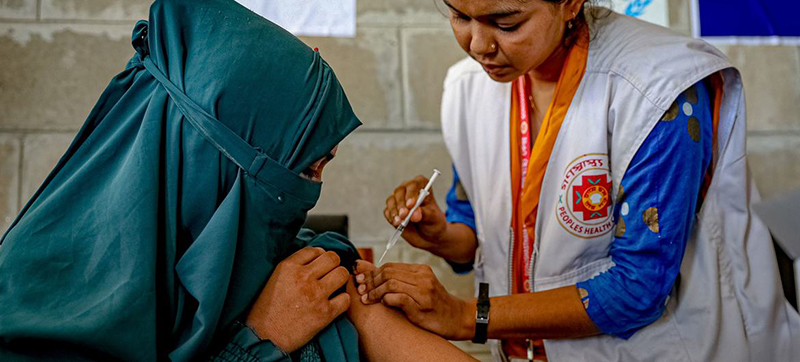
New York: Limited supply and unequal vaccine distribution means that lower-income countries consistently struggle to access essential inoculations in demand by wealthier countries, according to the latest Global Vaccine Market Report, released on Wednesday by the World Health Organization (WHO).
It is the first to examine the implications of COVID-19 for vaccine markets and highlights the disparity in access around the world.
The report says that the way the global market is not fully conducive to the development, supply and access for essential vaccines – with some regions depending almost entirely on others for vaccine supply.
“The right to health includes the right to vaccines”, said WHO Director-General Tedros Adhanom Ghebreyesus, adding that the report “shows that free-market dynamics are depriving some of the world's poorest and most vulnerable people of that right”.
Calling for change
WHO is calling for much-needed changes in vaccine distribution “to save lives, prevent disease and prepare for future crises”.
Although manufacturing capacity worldwide has increased, it remains highly concentrated. Ten manufacturers alone provide 70 per cent of vaccine doses, excluding those for COVID-19.
Several of the top 20 most widely used vaccines, such as the pneumococcal conjugate vaccine (PCV), and human papillomavirus (HPV), measles and rubella containing vaccines, each currently rely mostly on two suppliers.
Concentrated manufacturing risks shortages as well as regional supply insecurity.
In 2021, the African and Eastern Mediterranean regions were dependent on manufacturers headquartered elsewhere for 90 per cent of their vaccines.
Driving imbalances
Limited vaccine supply and unequal distribution drive global disparities, according to WHO.
The HPV vaccine against cervical cancer has been introduced in only 41 per cent of low-income countries – despite their carrying much of the disease burden – compared to 83 per cent of high-income countries.
Affordability is also an obstacle to vaccine access.
While prices tend to be tiered by income, price disparities see middle-income countries paying as much, or even more, than wealthier ones for several vaccine products.
Last year, approximately 16 billion vaccine doses, worth $141 billion, were supplied – representing almost three times the 2019 market volume of 5.8 billion and nearly three-and-a-half times that of its $38 billion market value.
The increase was primarily driven by COVID-19 vaccines, showing the incredible potential of how vaccine manufacturing can be scaled up in response to health needs.
WHO is calling on governments, manufacturers and partners to take ambitious action to guarantee equitable access to vaccines and improve responses to future pandemics.
Support Our Journalism
We cannot do without you.. your contribution supports unbiased journalism
IBNS is not driven by any ism- not wokeism, not racism, not skewed secularism, not hyper right-wing or left liberal ideals, nor by any hardline religious beliefs or hyper nationalism. We want to serve you good old objective news, as they are. We do not judge or preach. We let people decide for themselves. We only try to present factual and well-sourced news.
Support objective journalism for a small contribution.


