


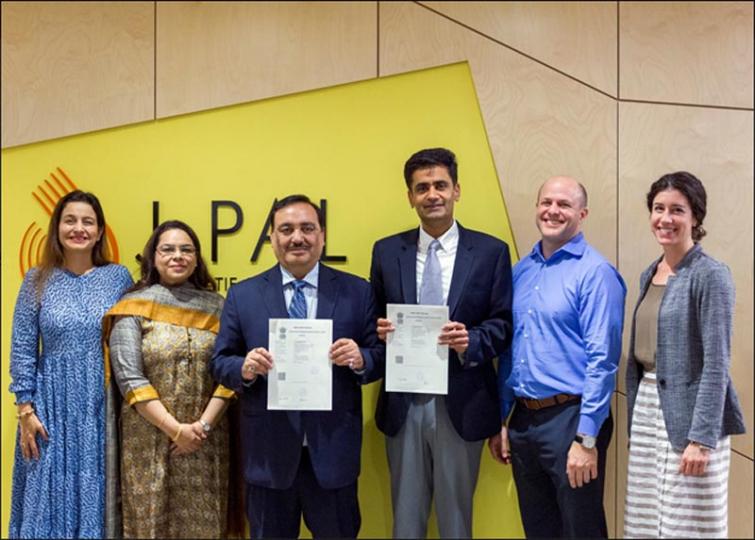
Haryana govt. partners with J-PAL South Asia to use data to improve health care
New Delhi, Oct 01 (IBNS): The National Health Mission (NHM), Government of Haryana and Abdul Latif Jameel Poverty Action Lab (J-PAL) South Asia have signed a Memorandum of Understanding (MoU) to systematically integrate the use of data and evidence from rigorous research to improve state programme implementation and health outcomes.
This partnership will also seek to build the capacity of Health Service Providers and departmental staff to improve the quality of data collected through the state government's health information systems, a release issued by J-PAL after the MoU signing said.
The NHM has committed to a continuous collaboration with J-PAL to apply data and results from rigorous impact evaluation to strengthen NHM decision-making, it said. To this end, NHM is expanding the coverage and use of its new health information systems for frontline workers, including the ANMOL (Auxiliary Nurse Midwives Online) application.
“We commend the NHM for launching this forward-looking the initiative, and for recognizing the importance of data-driven decision making in health policy design and service delivery,” said Aparna Krishnan, Project Director of J-PAL South Asia’s IDEA Lab.
“This partnership will allow NHM to strengthen its data collection systems, as well as undertake the systematic analysis of large volumes of data from ANMOL, e-upchaar and other digital platforms. Research facilitated by this data can then lead to stronger programme implementation in areas of maternal and child health, and non-communicable diseases, among others.”
The first engagement under the Memorandum of Understanding will be to leverage data from the ANMOL application to improve immunization rates through the identification of local “ambassadors” who can help increase community participation in immunization camps.
This signals the expansion of the innovative immunization intervention, which was found to be highly successful when recently evaluated by J-PAL affiliated researchers in partnership with the Haryana NHM.
This partnership was launched under J-PAL’s new “Innovations in Data, Experiments, and Action” (IDEA) initiative to expand the use of administrative data for decision-making through collaborative engagements with state and central government ministries.
The Abdul Latif Jameel Poverty Action Lab (J-PAL) is a global research center working to reduce poverty by ensuring that policy is informed by scientific evidence. Anchored by a network of 181 affiliated professors at universities around the world, J-PAL conducts randomized impact evaluations to answer critical questions in the fight against poverty.
J-PAL was launched at the Massachusetts Institute of Technology in 2003 and has 6 regional offices around the world. J-PAL South Asia is hosted by the Institute for Financial Management and Research (IFMR), Chennai, and has built partnerships for the generation of new research and the advancement of evidence-informed policymaking with 16 Indian state and central government ministries, as well as training partnerships with the governments of Nepal, Bhutan, Bangladesh, and Pakistan.
Support Our Journalism
We cannot do without you.. your contribution supports unbiased journalism
IBNS is not driven by any ism- not wokeism, not racism, not skewed secularism, not hyper right-wing or left liberal ideals, nor by any hardline religious beliefs or hyper nationalism. We want to serve you good old objective news, as they are. We do not judge or preach. We let people decide for themselves. We only try to present factual and well-sourced news.
Support objective journalism for a small contribution.


