


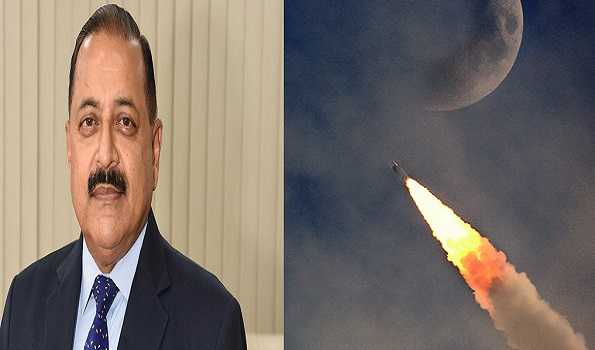
 Chandrayaan1
Images sent by Chandrayaan-1 indicate possible impact of Earth's atmosphere on Moon
New Delhi/UNI: Union Minister of State (Independent Charge) for Development of North Eastern Region (DoNER), MoS PMO, Personnel, Public Grievances, Pensions, Atomic Energy and MoS Space, Dr Jitendra Singh on Sunday said that ISRO’s maiden mission to the Moon has sent images, which show that Moon may be rusting along the poles.
The sign of this finding is that even though the surface of the Moon is known to have iron - rich rocks, it is not known for the presence of water and oxygen, which are the two elements needed to interact with iron to create rust, he said.
Scientists at the National Aeronautics and Space Administration (NASA) say that this could be because the Earth's own atmosphere is lending a helping hand which, in other words, means that the Earth's atmosphere could be protecting the Moon as well.
Thus, the Chandrayaan-1 Moon data indicates that the Moon's poles are home to water, this is what the scientists are trying to decipher.
Dr Singh said, as for Chandrayaan-3 is concerned, the launch may now take place somewhere in early 2021. Chandrayaan-3 will be a mission repeat of Chandrayaan-2 and will include a Lander and Rover similar to that of Chandrayaan-2, but will not have an orbiter.
Meanwhile, preparations are going on for India's first ever Human Space Mission Gaganyaan, said Dr Jitendra Singh. The training processes and other procedures are also in place.
Constraints due to COVID-19 pandemic led to some disruptions in the plan for Gaganyaan, but efforts were going on to stick to the timeline of around 2022, he added.
Support Our Journalism
We cannot do without you.. your contribution supports unbiased journalism
IBNS is not driven by any ism- not wokeism, not racism, not skewed secularism, not hyper right-wing or left liberal ideals, nor by any hardline religious beliefs or hyper nationalism. We want to serve you good old objective news, as they are. We do not judge or preach. We let people decide for themselves. We only try to present factual and well-sourced news.
Support objective journalism for a small contribution.


