


 Trachoma
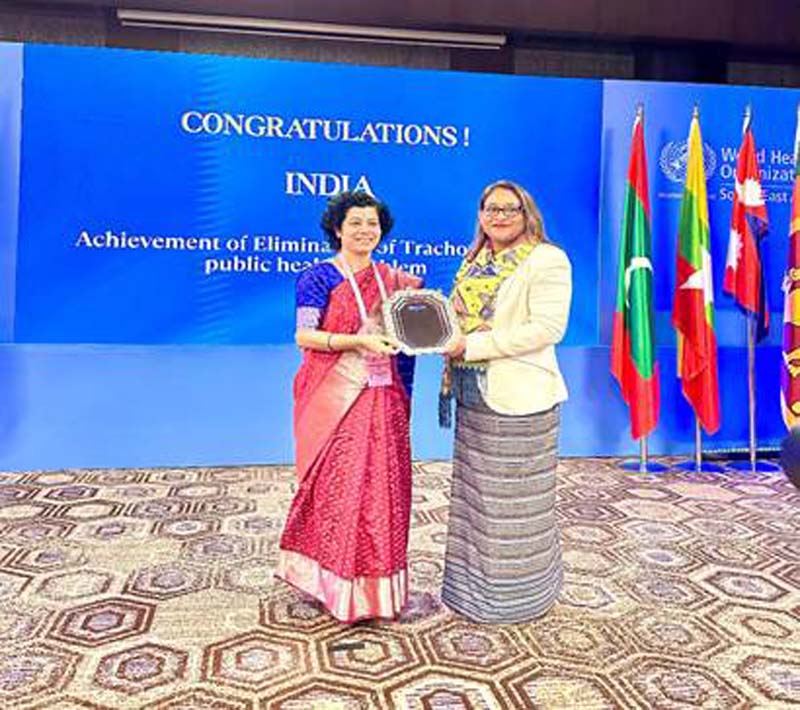
India has eliminated Trachoma as a public health problem in 2024, declares WHO
World Health Organisation (WHO) has declared that the Government of India has eliminated Trachoma as a public health problem becoming the third country in the South-East Asia Region to achieve this milestone.
An official Certification was handed over to Smt. Aradhana Patnaik, Additional Secretary and Mission Director, National Health Mission, Ministry of Health and Family Welfare by Saima Wazed, Regional Director, WHO South East Asia during the WHO’s South East Asia Region, Regional Committee meeting held at New Delhi, on Monday.
Trachoma is a bacterial infection that affects the eyes.
It is caused by the bacterium Chlamydia Trachomatis.
Trachoma is contagious, spreading through contact with the eyes, eyelids, nose or throat secretions of infected people, if left untreated it causes irreversible blindness.
WHO has termed Trachoma as a neglected tropical disease.
WHO estimates suggest that 150 million people worldwide are affected by Trachoma and 6 million of them are blind or at risk of visually disabling complications.
What is Trachoma?
Trachoma is found in underprivileged communities living in poor environmental conditions.
Trachoma was amongst the leading cause of blindness in the country during 1950-60.
The Government of India launched the National Trachoma Control Program in 1963 and later on Trachoma control efforts were integrated into India’s National Program for Control of Blindness (NPCB).
In 1971, blindness due to Trachoma was 5% and today, owing to the various interventions under the National Programme for Control of Blindness & Visual Impairment (NPCBVI), it has come down to less than 1%.
WHO SAFE strategy was implemented throughout the country wherein SAFE stands for adoption of surgery, antibiotics, facial hygiene, environmental cleanliness etc.
As a result, in 2017, India was declared free from infective Trachoma.
However, surveillance continued for trachoma cases in all the districts of India from 2019 onwards till 2024.
The National Trachomatous Trichiasis (TT only) Survey was also carried out in 200 endemic districts of the country under NPCBVI from 2021-24, which was a mandate set by WHO in order to declare that India has eliminated Trachoma as a public health problem.
All the reports were compiled in a specific dossier format by the NPCBVI team and were shared with the WHO country office for final scrutiny.
Finally, after years of fighting against Trachoma, WHO declared that India has eliminated Trachoma as a public health problem.
Support Our Journalism
We cannot do without you.. your contribution supports unbiased journalism
IBNS is not driven by any ism- not wokeism, not racism, not skewed secularism, not hyper right-wing or left liberal ideals, nor by any hardline religious beliefs or hyper nationalism. We want to serve you good old objective news, as they are. We do not judge or preach. We let people decide for themselves. We only try to present factual and well-sourced news.
Support objective journalism for a small contribution.


