


 Economic Survey
India needs to look at climate change from the local lens, says Economic Survey
Taking a critical view of the Western approach to tackling Climate Change, the Economic Survey 2023-24 gives a clarion call to all developing countries to look at climate change problem from a ‘local lens’.
It states that a ‘one-size-fits-all’ approach will not work, and developing countries need to be free to choose their own pathways since they are tasked with balancing developmental goals with meaningful climate action.
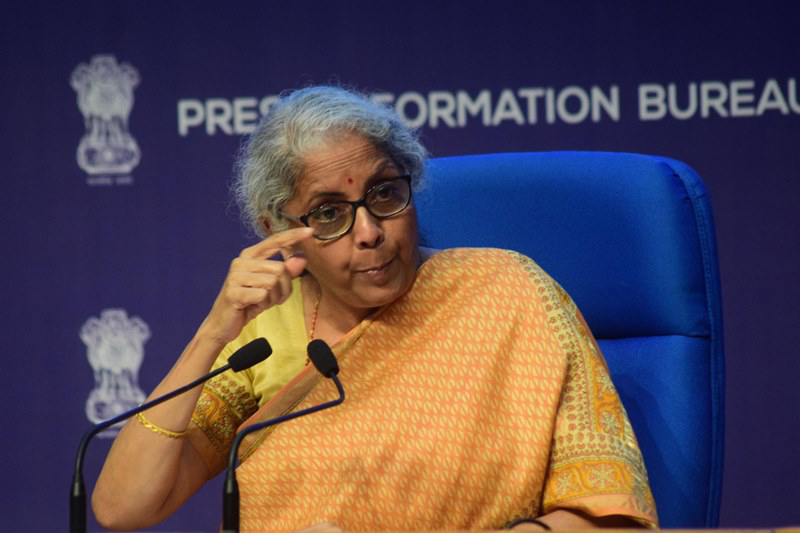
The Economic Survey 2023-24, tabled by the Union Minister for Finance and Corporate Affairs Nirmala Sitharaman in Parliament today, clearly states that current global strategies for climate change are flawed and not universally applicable.
It states that adopting the practices of the West could prove to be disastrous for India where culture, economy, societal norms are already intertwined with the environment.
The document highlights that India, despite making significant strides in climate action, often faces criticism for not aligning with Western solutions.
This criticism stems from a lack of appreciation for India's unique social and cultural fabric, which is already rich with sustainable development ideas.
It further goes on to point out inherent inconsistencies where the prescriptions to tackle Climate Change from the developed world do not hold ground globally. These are:
The Western approach does not seek to address the root of the problem, i.e. overconsumption, but rather chooses to substitute the means to achieve overconsumption.
The global pursuit of energy-guzzling technologies such as Artificial Intelligence and mining rare earth minerals in large quantities has only contributed to higher fossil fuel consumption. This is directly at odds with the stated objectives of climate change mitigation.
Lifestyles in developed countries ignore humans’ underlying relationship with Nature, with other people, with materiality and with themselves.
The Economic Survey 2023-24 stresses that India’s ethos emphasizes a harmonious relationship with nature, in sharp contrast to the culture of overconsumption prevalent in other parts of the developed world, thus offering sustainable solutions to problems plaguing Western societies. For instance:
The process of meat production adopted in the developed world presents credible food security risks and a threat of permanently degrading the land, water and natural resources critical for human survival.
The reliance on human-edible crops to feed livestock has set into motion a ‘food-feed competition’ as less than half the cereals produced today go towards direct human consumption.
These figures are even lower for many developed economies.
The Survey notes that traditional farming practices from the developing world, where several agricultural activities are integrated with livestock rearing, offer one solution to the problem.
Repurposing farm waste and by-products from other agricultural activities as animal feed not only lowers the financial and environmental cost of meat production but also brings balance to the natural cycle.
Shifting livestock to human-inedible feed can free up significant shares of global arable land to address global hunger, it adds.
Similarly, the adoption of nucleated families akin to the Western model of living places significant land and resource requirements on the environment, as the growth in urban nucleated settlements gives rise to the tendency of ‘urban sprawl’.
Furthermore, these living spaces are highly inefficient, dominated by concrete, closed spaces, less ventilation and exacting higher energy costs during the summers.
A shift towards the ‘traditional multi-generational households’ would create the pathway towards sustainable housing, notes the Survey.
Sourcing materials and labour locally for the construction of houses, central courtyards with well-ventilated spaces, and avenues for natural lighting and cooling would all exert a positive externality on the environment by lowering resource and energy requirements.
Such a household would also prove immensely beneficial for the elderly, it states.
In order to profess a solution to these issues, the Economic Survey brings in perspective Prime Minister Narendra Modi’s vision of Mission LiFE.
It embodies a ‘Lifestyle For Environment’ seeking to address the ‘wants’ of the people without letting them hurt Nature.
The approach seeks to bring individual responsibility to the forefront of the fight against climate change, as sustenance is at the core of Indian ethos.
Support Our Journalism
We cannot do without you.. your contribution supports unbiased journalism
IBNS is not driven by any ism- not wokeism, not racism, not skewed secularism, not hyper right-wing or left liberal ideals, nor by any hardline religious beliefs or hyper nationalism. We want to serve you good old objective news, as they are. We do not judge or preach. We let people decide for themselves. We only try to present factual and well-sourced news.
Support objective journalism for a small contribution.


