


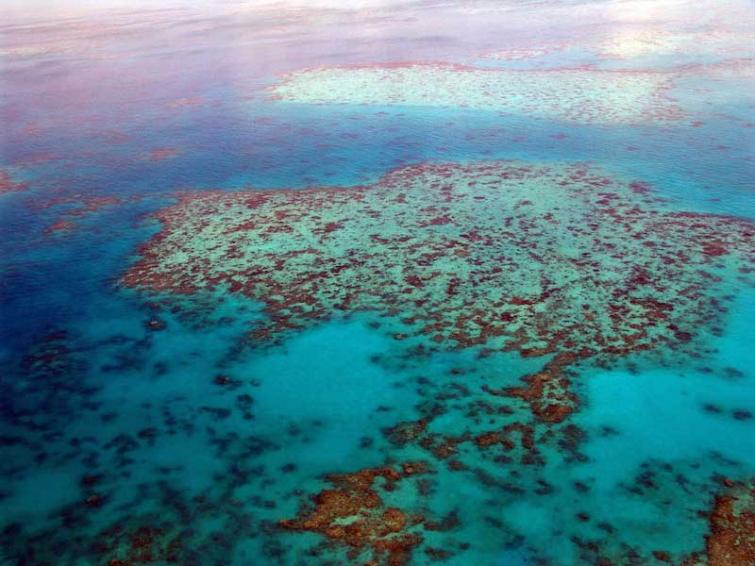
Mass decline in 'coral babies' at Great Barrier Reef, say scientists
Sydney, Apr 4 (UNI): The number of new corals on Australia's Great Barrier Reef has plunged by 89 per cent since unprecedented bleaching events in 2016 and 2017, scientists say.
The Great Barrier Reef, off the coast of Queensland in northeastern Australia, is the largest living thing on Earth, and even visible from outer space. The 2,300km-long ecosystem comprises thousands of reefs and hundreds of islands made of over 600 types of hard and soft coral. It's home to countless species of colourful fish, molluscs and starfish, plus turtles, dolphins and sharks.
The events, which damaged two-thirds of the world's largest reef system, are now being blamed for triggering a collapse in coral re-growth last year.
"Dead corals don't make babies," said lead author Prof Terry Hughes, from Queensland's James Cook University.
The scientists blame the problem on rising sea temperatures.
The research, published in journal Nature on Thursday, was carried out by a group of scientists last year.
It measured how many adult corals along the reef had survived following the mass bleaching events, and the number of new corals that had been produced.
"Across the length of the Great Barrier Reef, there was an average 90 per cent decline from historical [1990s] levels of recruitment," co-author Prof Andrew Baird told the BBC.
The study highlights the link between coral vulnerability and rising sea temperatures resulting from sustained global warming, and recommends increased international action to reduce carbon emissions.
Coral bleaching is caused by rising temperatures and occurs when corals under stress drive out the algae - known as zooxanthellae - that give them colour. If normal conditions return, the corals can recover. But it can take decades, and if the stress continues the corals can die.
Prof Baird said the "pretty extraordinary" decline was unexpected. It was most likely the reef's first re-growth problem on a mass scale, he added.
"Babies can travel over vast distances, and if one reef is knocked out, there are usually plenty of adults in another reef to provide juveniles," Prof Baird said.
However, the bleaching in 2016 and 2017 affected a 1,500km (900 miles) stretch of the reef.
"Now, the scale of mortality is such that there's nothing left to replenish the reef," Prof Baird said.
The study also found that the mix of baby coral species had changed. It found a 93 per cent drop in Acropora, a species which typically dominates a healthy reef and provides habitats for thousands of other species.
The researchers said coral replenishment could recover over the next five to 10 years if there were no future bleaching events.
However, given current estimates, this likelihood was "almost inconceivable", said Prof Baird.
"We've gotten to the point now where local solutions for the reef are almost pointless - the only thing that matters is action on climate change," Prof Baird said.
The reef - a vast collection of thousands of smaller coral reefs stretching from the northern tip of Queensland to the state's southern city of Bundaberg - was given World Heritage status in 1981.
The UN says it is the "most biodiverse" of all the World Heritage sites, and of "enormous scientific and intrinsic importance".
Support Our Journalism
We cannot do without you.. your contribution supports unbiased journalism
IBNS is not driven by any ism- not wokeism, not racism, not skewed secularism, not hyper right-wing or left liberal ideals, nor by any hardline religious beliefs or hyper nationalism. We want to serve you good old objective news, as they are. We do not judge or preach. We let people decide for themselves. We only try to present factual and well-sourced news.
Support objective journalism for a small contribution.


