NASA Cargo launches to space station aboard SpaceX resupply mission
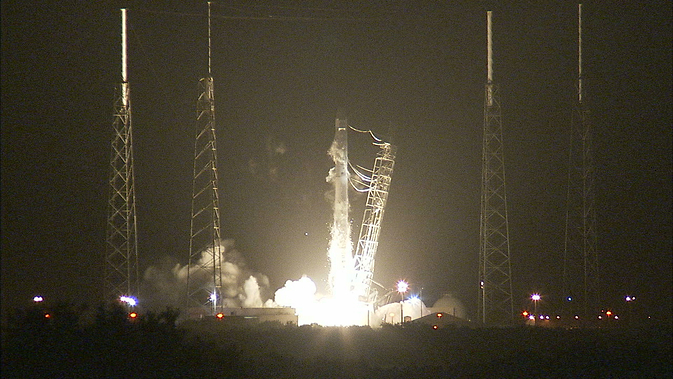
The cargo ship launched on the company's Falcon 9 rocket from Space Launch Complex-40 at Cape Canaveral Air Force Station in Florida at 1:52 a.m. EDT Sunday.
The mission is the company's fourth cargo delivery flight to the space station through a $1.6 billion NASA Commercial Resupply Services contract. Dragon's cargo will support experiments to be conducted by the crews of space station Expeditions 41 and 42.
One of the new Earth science investigations heading to the orbital laboratory is the International Space Station-Rapid Scatterometer. ISS-RapidScat monitors ocean winds from the vantage point of the space station.
This space-based scatterometer is a remote sensing instrument that uses radar pulses reflected from the ocean's surface from different angles to calculate surface wind speed and direction. This information will be useful for weather forecasting and hurricane monitoring.
Dragon also will deliver the first-ever 3-D printer in space. The technology enables parts to be manufactured quickly and cheaply in space, instead of waiting for the next cargo resupply vehicle delivery.
The research team also will gain valuable insight into improving 3-D printing technology on Earth by demonstrating it in microgravity.
New biomedical hardware launched aboard the spacecraft will help facilitate prolonged biological studies in microgravity. The Rodent Research Hardware and Operations Validation (Rodent Research-1) investigation provides a platform for long-duration rodent experiments in space.
These investigations examine how microgravity affects animals, providing information relevant to human spaceflight, discoveries in basic biology and knowledge that may have direct impact toward human health on Earth.
The Dragon spacecraft also will transport other biological research, including a new plant study. The Biological Research in Canisters (BRIC) hardware has supported a variety of plant growth experiments aboard the space station.
The BRIC-19 investigation will focus on the growth and development in microgravity of Arabidopsis thaliana seedlings, a small flowering plant related to cabbage. Because plant development on Earth is impacted by mechanical forces such as wind or a plant’s own weight, researchers hope to improve understanding of how the growth responses of plants are altered by the absence of these forces when grown in microgravity.
Dragon is scheduled to be grappled at 7:04 a.m. on Tuesday, Sept. 23, by Expedition 41 Flight Engineer Alexander Gerst of the European Space Agency, using the space station's robotic arm to take hold of the spacecraft. NASA's Reid Wiseman will support Gerst in a backup position. Dragon is scheduled to depart the space station in mid-October for a splashdown in the Pacific Ocean, west of Baja California, bringing from the space station almost 3,200 pounds of science, hardware and crew supplies.
The space station is a convergence of science, technology and human innovation that demonstrates new technologies and makes research breakthroughs not possible on Earth. NASA recently awarded contracts to SpaceX and The Boeing Company to transport U.S. crews to and from the space station with the goal of certifying those transportation systems in 2017.
Image Credit: NASA Television
Support Our Journalism
We cannot do without you.. your contribution supports unbiased journalism
IBNS is not driven by any ism- not wokeism, not racism, not skewed secularism, not hyper right-wing or left liberal ideals, nor by any hardline religious beliefs or hyper nationalism. We want to serve you good old objective news, as they are. We do not judge or preach. We let people decide for themselves. We only try to present factual and well-sourced news.
Support objective journalism for a small contribution.