


NASA sends fire, meteor experiments to International Space Station on Commercial Cargo Spacecraft
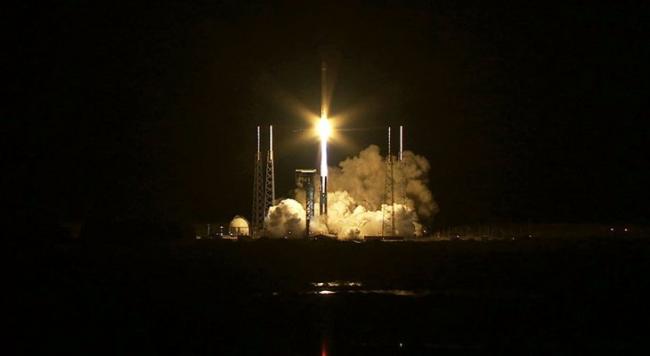
The station’s Expeditions 47 and 48 crews will employ these science payloads to support experiments in biology, biotechnology, physical science and Earth science – research that improves life on Earth -- including:Orbital ATK’s fifth cargo delivery flight under its Commercial Resupply Services contract with NASA launched at 11:05 p.m. EDT Tuesday on a United Launch Alliance Atlas V rocket from Space Launch Complex 41 on Cape Canaveral Air Force Station in Florida. The Cygnus is scheduled to arrive at the orbiting laboratory Saturday, March 26.
Saffire-I provides a new way to study a large fire on an exploration craft, which has not been possible in the past because the risks for performing such studies on spacecraft with astronauts aboard are too high.
Meteor will enable the first space-based observations of meteors entering Earth’s atmosphere from space.
Strata-I could give us answers about how regolith behaves and moves in microgravity, how easy or difficult it is to anchor a spacecraft in regolith, how it interacts with spacecraft and spacesuit materials, and other important properties.
The Gecko Gripper study tests a gecko-inspired adhesive gripping device that can stick on command in the harsh environment of space.
The Additive Manufacturing Facility will add an upgraded 3-D printing capability to the station.
NASA astronaut and Expedition 46 Commander Tim Kopra will capture Cygnus at about 6:40 a.m. Saturday, March 26, using the space station's Canadarm2 robotic arm to take hold of the spacecraft. Astronaut Tim Peake of ESA (European Space Agency) will support Kopra in a backup position. NASA TV coverage of capture will begin at 5:30 a.m.
Saffire-1 will remain on the spacecraft once all the other supplies are unloaded, and the vehicle will be attached to the space station for about two months. Once it departs and the spacecraft is a safe distance from the space station, engineers will remotely conduct the first Saffire experiment before the Cygnus’ destructive reentry into Earth’s atmosphere. Before detaching from the station, Cygnus will also be filled with about 3,000 pounds of trash, which will be burned up over the Pacific Ocean.
This is the second flight of an enhanced Cygnus spacecraft, and the second using the Atlas V launch system. The cargo freighter features a greater payload capacity, supported by new fuel tanks and solar arrays, and an extended pressurized cargo module that increases the spacecraft’s interior volume by 25 percent, enabling more cargo to be delivered with each launch.
The space station is a convergence of science, technology and human innovation that demonstrates new technologies and makes research breakthroughs not possible on Earth. The space station has been continuously occupied since November 2000. In that time, it has been visited by more than 200 people and a variety of international and commercial spacecraft. The space station remains the springboard to NASA's next great leap in exploration, including future missions to an asteroid and Mars.
Image: NASA
Support Our Journalism
We cannot do without you.. your contribution supports unbiased journalism
IBNS is not driven by any ism- not wokeism, not racism, not skewed secularism, not hyper right-wing or left liberal ideals, nor by any hardline religious beliefs or hyper nationalism. We want to serve you good old objective news, as they are. We do not judge or preach. We let people decide for themselves. We only try to present factual and well-sourced news.
Support objective journalism for a small contribution.


