


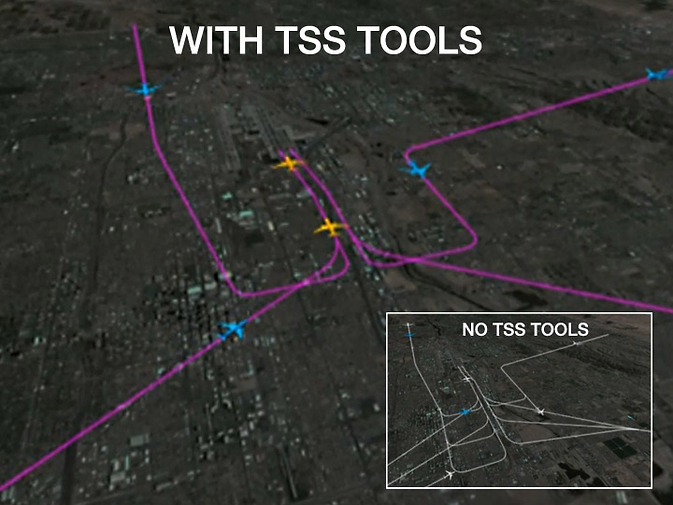
NASA turns over next-generation air traffic management tool to Federal Aviation Administration
The Terminal Sequencing and Spacing (TSS) technology will enable air traffic controllers to better manage the spacing between aircraft as they fly more efficient approaches into airports, saving both time and fuel and reducing emissions.
TSS is the another step in NASA’s support of the development of a Next Generation Air Transportation System, or NextGen, which is a joint multi-agency and industry initiative to modernize and upgrade the nation's air traffic control system.
"With TSS, NASA's aeronautics innovators have delivered to the FAA another valuable tool that will soon benefit our environment, our economy and every individual traveler," said Jaiwon Shin, NASA's associate administrator for aeronautics research.
The software enables the routine use of what are called Performance Based Navigation procedures, resulting in fewer course and altitude changes, while also reducing the frequency of necessary communications between controllers and pilots.
The TSS tool provides information to controllers about the speeds they should assign to aircraft as they follow fuel-efficient, continuous-descent arrival procedures while passing through a region of airspace surrounding an airport called the TRACON (Terminal Radar Approach Control), covering a distance from an airport of about 50 miles.
NASA's Airspace Systems Program, which is part of the agency's Aeronautics Research Mission Directorate, began the research that led to the development of TSS in 2009, with prototype development beginning in 2011. NASA used these prototypes to test TSS in 16 high-fidelity simulations involving controllers and pilots.
The FAA is working to implement the tool in the next five years, targeting an initial operating capability around 2018. The initial site has not yet been determined and implementation will depend on funding availability.
Through a highly effective technology transfer process enabled by the NASA/FAA Research Transition Teams, NASA has delivered to the FAA three other key software tools that enable more efficient air traffic and fuel savings.
Image credit: NASA
Support Our Journalism
We cannot do without you.. your contribution supports unbiased journalism
IBNS is not driven by any ism- not wokeism, not racism, not skewed secularism, not hyper right-wing or left liberal ideals, nor by any hardline religious beliefs or hyper nationalism. We want to serve you good old objective news, as they are. We do not judge or preach. We let people decide for themselves. We only try to present factual and well-sourced news.
Support objective journalism for a small contribution.


