


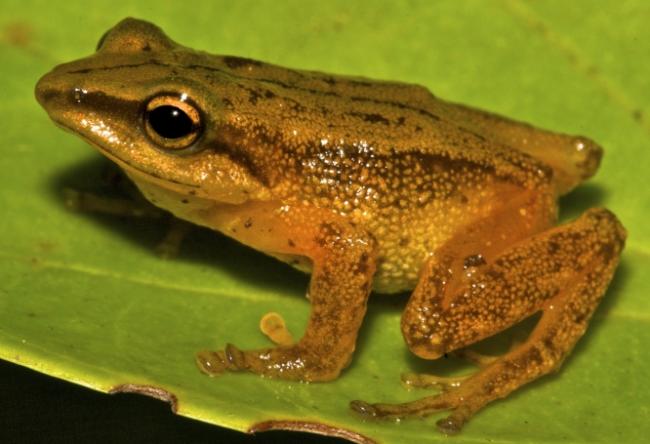
New golden frog species discovered in Colombia
Its name, Pristimantis dorado,commemorates both its color (dorado means “golden” in Spanish) and El Dorado, a mythical city of gold eagerly sought for centuries by Spanish conquistadores in South America.
“The Spaniards assumed Colombia’s wealth was its gold, but today we understand that the real riches of the country lie in its biodiversity,” said Andrew Crawford, a STRI research associate and faculty member at the Universidad de Los Andes.
The extraordinarily diverse group to which the new species belongs, Pristimantis, includes 465 recognized species, 205 of them from Colombia.
The mountainous terrain of the Andes probably led to the evolution of so many different ground-dwelling frogs, in which the eggs develop directly into tiny baby frogs without going through a tadpole phase. At seven-tenths of an inch long, the species is among the smaller species in the group. The largest species grow to be 2 inches in length.
Males of many frog species advertise for females with distinctive calls produced by vocal sacs or vocal slits. Oddly, although the new species lacks these structures, males are still able to produce calls consisting of an irregularly pulsed series of clicks.
The new species was found calling from bushes along a roadside at about 8,700 feet elevation near Chingaza National Park, roughly10 miles east of Bogotá, Colombia’s capital and largest city. Its discovery so close to a metropolitan area of nearly 10 million inhabitants illustrates how much of the planet’s biodiversity remains to be discovered.
“With this new species, Colombia now hosts 800 species of amphibians, second only to Brazil in total diversity,” said Crawford. “Every year there are increasing numbers of new species of amphibians discovered and described. At this point we still can’t even estimate what the final diversity of amphibians will be.”
Support Our Journalism
We cannot do without you.. your contribution supports unbiased journalism
IBNS is not driven by any ism- not wokeism, not racism, not skewed secularism, not hyper right-wing or left liberal ideals, nor by any hardline religious beliefs or hyper nationalism. We want to serve you good old objective news, as they are. We do not judge or preach. We let people decide for themselves. We only try to present factual and well-sourced news.
Support objective journalism for a small contribution.


