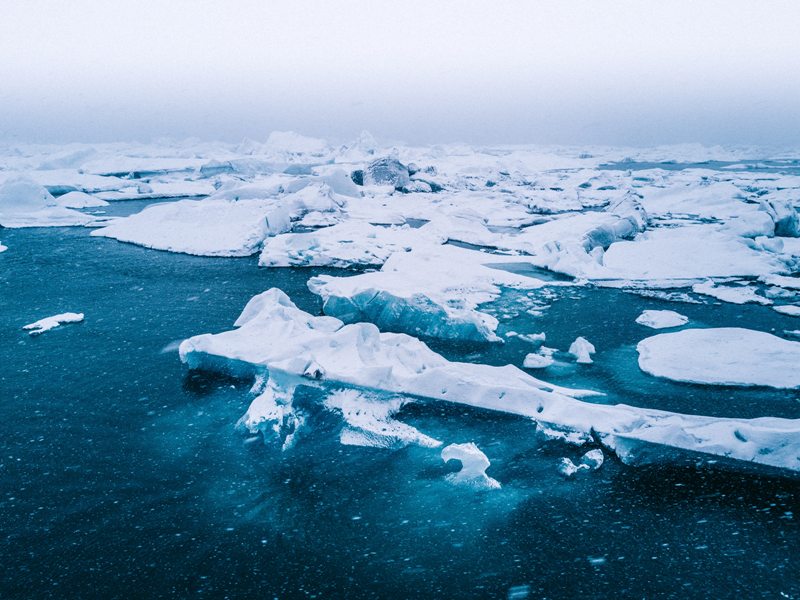
 Arctic Ice Melt
Newest satellite data reveals remarkable decline in Arctic sea ice over just three years
Washington: In the past 20 years, the Arctic has lost about one-third of its winter sea ice volume, according to a new study by researchers at the University of Washington and the California Institute of Technology.
That decline is largely due to loss of older, multiyear sea ice. New satellite data also show that wintertime Arctic sea ice is likely thinner than previous estimates.
The study was published March 10 in Geophysical Research Letters.
“The key takeaway, for me, is the remarkable loss of Arctic winter sea ice volume — one-third of the winter ice volume lost over just 18 years — that accompanied a widely reported loss of old, thick Arctic sea ice, and decline in end-of-summer ice extent,” said co-author Ron Kwok, a polar scientist at the UW Applied Physics Laboratory.
Seasonal sea ice, which melts completely each summer rather than accumulating over years, is replacing thicker, multiyear ice. This switch is largely responsible for the sea ice thinning, according to the new research.
“Arctic snow depth, sea ice thickness and volume are three very challenging measurements to obtain,” Kwok remarked.
The newest technology, a combination of ICESat-2 lidar data and CryoSat-2 radar data, is able for the first time to estimate the depth of the snow on top of the Arctic sea ice. Using snow depth and the height of sea ice exposed above water, the study found that multiyear Arctic sea ice lost 16% of its winter volume, or approximately half a meter (about 1.5 feet) of thickness, in the three years since the launch of ICESat-2 in 2018.
“We weren’t really expecting to see this decline, for the ice to be this much thinner in just three short years,” said lead author Sahra Kacimi at CalTech’s Jet Propulsion Laboratory.
Scientists estimate sea ice thickness using snow depth and the height of the floating ice above the sea surface. Snow can weigh ice down, changing how ice floats in the ocean. The new study compared ice thickness using snow depths from satellite radar and lidar to previous observations of ice thickness and snow depth from climate records. The comparisons show that using climatology-based estimates of snow depth can result in overestimating sea ice thickness by up to one-fifth, or as much as 20 centimeters (0.7 feet).
To provide context for sea ice thickness estimates from 2018 to 2021, the study used an 18-year record of sea ice observations spanning the older ICESat records and the newer ICESat-2 and CryoSat-2 satellites to capture monthly changes in Arctic sea ice thickness and volume. The longer 18-year record showed a loss of about 6,000 cubic kilometers (1,400 cubic miles) of winter ice volume, or about one-third, largely driven by the switch from predominantly multiyear ice to thinner, seasonal sea ice.
Older, multiyear ice tends to be thicker and therefore more resistant to melting. As that “reservoir” of old Arctic sea ice declines and seasonal ice becomes the norm, the overall thickness and volume of Arctic sea ice is expected to drop further.
“Current models predict that by the mid-century we can expect ice-free summers in the Arctic, when the older ice, thick enough to survive the melt season is gone,” Kacimi said.
Support Our Journalism
We cannot do without you.. your contribution supports unbiased journalism
IBNS is not driven by any ism- not wokeism, not racism, not skewed secularism, not hyper right-wing or left liberal ideals, nor by any hardline religious beliefs or hyper nationalism. We want to serve you good old objective news, as they are. We do not judge or preach. We let people decide for themselves. We only try to present factual and well-sourced news.
Support objective journalism for a small contribution.