


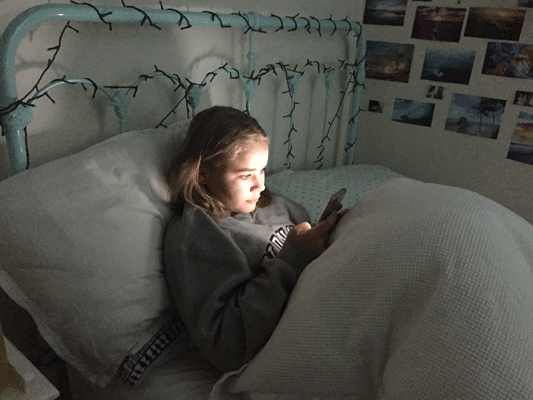
Night phone use a danger for adolescent mental heath, says study
Research conducted by Griffith University and Murdoch University tracked changes in late-night mobile phone use, sleep, and mental health indicators over three years in a large sample of Australian teens.
They found that adolescents’ late-night mobile phone use was directly linked to poor quality sleep, which subsequently led to poorer mental health outcomes, reduced coping, and lowered self-esteem.
Lead researcher Lynette Vernon, who conducted the study as part of her PhD, said this was the first longitudinal study that had investigated how night phone use and mental health were connected.
“We have demonstrated how poor sleep is the key link connecting an increase in night-time mobile use with subsequent increases in psychosocial issues,” Vernon said.
“Heavy mobile phone use becomes a problem when it overtakes essential aspects of adolescent life. In this case, we see issues when it overtakes time set-aside for sleep.
“We found that late night phone use directly contributed to poor sleep habits, which over time led to declines in overall wellbeing and mental health.”
The research was part of the Youth Activity Participation Study, funded by the Australian Research Council. The study surveyed 1100 students from 29 schools annually over four years in total, starting in Year 8 and following them until Year 11.
Students were asked what time of the night they received or sent text messages and phone calls, and their perceptions of their sleep quality.
The researchers also investigated adolescents’ symptoms of depressed mood, involvement in delinquency or aggression, and their coping and self esteem over time.
Results showed that in Year 8, more than 85% of students owned a mobile phone and around one-third of these students reported they never texted or received phone calls after lights out.
But three years later 93% of the students owned mobiles and only 22% of these Year 11 students reported no late night mobile use.
“We found that those teenagers who start out as relatively ‘healthy’ in terms of their late-night mobile use early in high school, tend to show steeper escalations in their late-night mobile use over the next several years,” said study co-author Kathryn Modecki from Griffith’s Menzies Health Institute Queensland.
“This means that even when teens appear to have their technology and sleep under control early-on, they still require monitoring and education as they mature.”
“Students with high initial levels of night-time mobile phone use also tended to have higher initial levels of poor sleep behaviour,” Vernon said.
“As their levels of mobile phone use grew over time, so did their poor sleep behaviour.”
“What is especially compelling” said Modecki, “is that these increases in poor sleep, in turn, led to rises in depressed mood and externalizing behaviours, and declines in self-esteem and coping one year later,” said Modecki.
“These effects were highly robust, across the various outcomes Vernon examined.”
Vernon said that although these results were concerning, the answer was not as simple as just banning adolescent phone use.
“There are many potential benefits of mobile technology, but these results demonstrate the importance of adults ‘meeting teens where they are’, enforcing electronic curfews, and teaching good sleep habits during the high school years.”
The study has been published in a special section of Child Development.
Image courtesy: Griffith University Website
Support Our Journalism
We cannot do without you.. your contribution supports unbiased journalism
IBNS is not driven by any ism- not wokeism, not racism, not skewed secularism, not hyper right-wing or left liberal ideals, nor by any hardline religious beliefs or hyper nationalism. We want to serve you good old objective news, as they are. We do not judge or preach. We let people decide for themselves. We only try to present factual and well-sourced news.
Support objective journalism for a small contribution.


