


 Northern Hemisphere
Northern hemisphere summer marked by heatwaves and wildfires: WMO
New York: A summer of extreme weather in the northern hemisphere is causing major damage to people’s health and the environment, the World Meteorological Organization (WMO) reported on Monday, as countries from the United States to China battle intense heat.
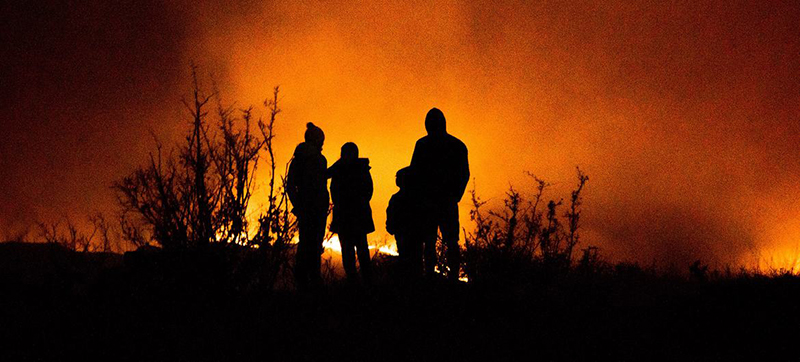
Record temperatures have been reported on land and in the sea, while wildfires have sparked devastation, caused dozens of casualties, and forced thousands to be evacuated.
Last week, scientists from the UN agency and the European Commission’s Copernicus Climate Change Service said new data showed that July was on track to be the warmest month on record.
‘The new normal’
WMO said the temperature in Xinjiang province in China reached 52.2 °C on 16 July, setting a new national record. The US city of Phoenix also experienced 31 consecutive days of temperatures above 110 °F, roughly 43.3 °C.
Sea surface temperatures have hit new records, with severe marine heatwaves in the Mediterranean and off the coast of Florida. Many parts of the US state, including the city of Miami, have been hit by an extended, record-breaking heatwave.
“The extreme weather – an increasingly frequent occurrence in our warming climate – is having a major impact on human health, ecosystems, economies, agriculture, energy and water supplies. This underlines the increasing urgency of cutting greenhouse gas emissions as quickly and as deeply as possible,” said Petteri Taalas, the WMO Secretary-General.
“In addition, we have to step up efforts to help society adapt to what is unfortunately becoming the new normal.”
Wildfires and evacuations
WMO said France, Greece, Italy, Spain, Algeria and Tunisia also reported new peaks in daytime and nighttime temperatures.
For example, in Figueres, Spain, a record temperature of 45.4°C was recorded on 18 July, while the mercury reached 48.2°C on 24 July in Sardinia, Italy. Algeria and Tunisia recorded temperatures of 48.7°C and 49.0°C, respectively, on 23 July.
Meanwhile, wildfires have prompted the evacuation of hundreds of residents and tourists from three Greek islands - Rhodes, Evia and Corfu – since 17 July. Fires also caused several dozen casualties in Algeria.
Fires in the Arctic
Hot, dry conditions were also behind an early and intense wildfire season in Canada, where more than 120,000 people were forced to flee their homes.
More than 1.1 million hectares have already burnt, according to the Canadian Interagency Forest Fire Centre, compared to the 10-year average of about 800,000 hectares.
Smoke from the fires polluted the air, affecting millions across North America. Additionally, numerous fires have broken out within Canada’s Arctic Circle in recent days.
In response to extreme weather, WMO and partners are providing forecasts and warnings to protect lives and livelihoods, in line with a UN plan towards ensuring all people on the planet are covered by early warning systems by 2027.
Support Our Journalism
We cannot do without you.. your contribution supports unbiased journalism
IBNS is not driven by any ism- not wokeism, not racism, not skewed secularism, not hyper right-wing or left liberal ideals, nor by any hardline religious beliefs or hyper nationalism. We want to serve you good old objective news, as they are. We do not judge or preach. We let people decide for themselves. We only try to present factual and well-sourced news.
Support objective journalism for a small contribution.


