


 Indian Institute of Astrophysics
Scientists at Indian Institute of Astrophysics propose new metric to help quantify image quality of Sun captured by ground-based telescopes
Bengaluru/IBNS: The scientists at the Indian Institute of Astrophysics (IIA) have proposed a novel metric called the root mean square (rms) granulation contrast to quantify the image quality of ground-based solar telescopes.
The quality of the images obtained from ground-based telescopes cannot be quantified with the Strehl ratio or other metrics used directly for nighttime astronomical telescopes.
As Sun is the closest star to Earth, it is the focus of interest of astronomers, as it can be studied in great detail, and properties of other stars may be extrapolated by the understanding of the Sun.
However, to resolve even the smallest features in greater detail, large telescopes are built-- one of them, the 2 m National Large Solar Telescope (NLST) at Merak, being deliberated by the Indian Institute of Astrophysics (IIA).
But the light from the Sun passes through the Earth’s atmosphere, which is not a homogenous medium. There are random temperature fluctuations that lead to refractive index fluctuations.
This causes the light to bend randomly and can be observed as the variation of intensity (scintillation/twinkling) and position of the image on the detector.
One way to overcome this is to use an adaptive optics (AO) system to measure and correct for the distortions introduced by the atmosphere in real time.
Scientists Saraswathi Kalyani Subramanian and Sridharan Rengaswamy at IIA have proposed that we can quantify the performance of the AO system or quantitatively evaluate the quality of images from ground-based telescopes using the root mean square (rms) granulation contrast.
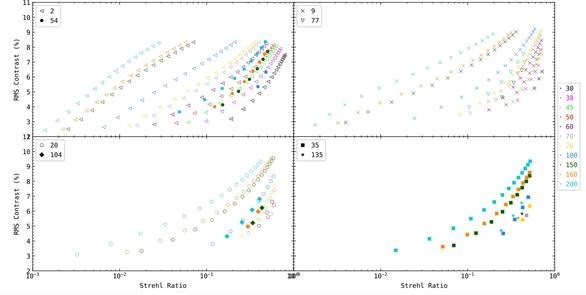
Using theories that can be used to explain the turbulence introduced by the atmosphere, the scientists Saraswathi Kalyani Subramanian and Sridharan Rengaswamy performed simulations of how an image would look when there is no atmospheric turbulence (ideal case) and compared to the image when there is an atmosphere (perturbed image) and when AO correction is done.
They considered telescope apertures (D) that reflect the sizes of existing or planned Solar telescopes in India and around the world and determined the Strehl ratio and contrast of the granulation for various combinations of their input parameters.
Since it is a simulation, the Strehl ratio can be easily determined, while in a practical system, it cannot be determined easily.
Comparing the results of the idealistic simulations to practical systems, they computed an efficiency factor deriving an efficiency of about 40 to 55% for the Strehl ratio and about 50% as a lower bound for contrast.
Their results will be useful in characterising the performance of any solar telescope and associated AO system.
Publication link: https://doi.org/10.1007/s11207-022-02105-2
Support Our Journalism
We cannot do without you.. your contribution supports unbiased journalism
IBNS is not driven by any ism- not wokeism, not racism, not skewed secularism, not hyper right-wing or left liberal ideals, nor by any hardline religious beliefs or hyper nationalism. We want to serve you good old objective news, as they are. We do not judge or preach. We let people decide for themselves. We only try to present factual and well-sourced news.
Support objective journalism for a small contribution.


