


Stepped-up efforts needed to combat pneumonia; save nearly nine million children’s lives
New York/IBNS: Scaling up pneumonia-related interventions could save the lives of nearly nine million children during the course of the next decade, the United Nations Children’s Fund said on Wednesday.
According to a new scientific model produced by Johns Hopkins University, in the United States, improving pneumonia treatment and prevention services could prevent up to 3.2 million children under the age of five from dying.
At the same time, it would create ‘a ripple effect’ that would prevent the deaths of an additional 5.7 million children from other major childhood diseases, underscoring the need for integrated health services.
Coronavirus shows needs for action
Wisdom was born four months ago in Nigeria, where more children die from pneumonia than in any other country. But today, he is getting vaccinated - an easy and affordable way of preventing the deadly disease. Every child has a right to the same protection.#StopPneumonia
“If we are serious about saving the lives of children, we have to get serious about fighting pneumonia”, said UNICEF Executive Director Henrietta Fore. “As the current coronavirus outbreak shows, this means improving timely detection and prevention”.
Pneumonia is caused by bacteria, viruses or fungi, and leaves children fighting for breath as their lungs fill with pus and fluid. The current coronavirus epidemic which began in China, causes pneumonia and other respiratory diseases in patients.
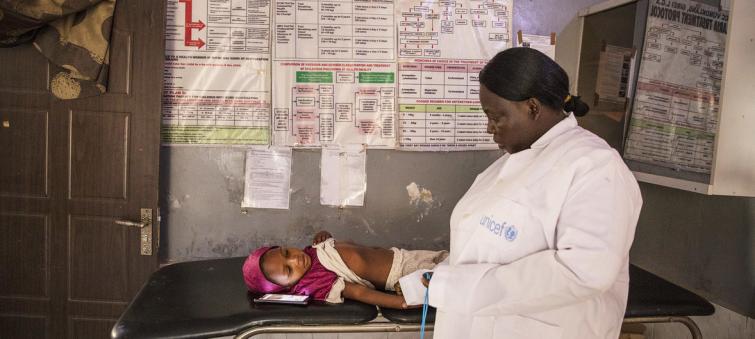
Pneumonia is the biggest single killer of children worldwide and claimed 800,000 last year, or one child every 39 seconds.
Although some types of pneumonia can be easily prevented with vaccines and treated with low-cost antibiotics, tens of millions of children remain unvaccinated and one-in-three children with symptoms do not receive medical care.
Fighting pneumonia means “making the right diagnosis and prescribing the right treatment”, the UNICEF chief spelled out.
Prevention yields results
Deprived and marginalized children in the world’s poorest countries are most affected by the killer disease.
Current trends forecast that 6.3 million children under-five could die from the infection between 2020 and 2030 with the highest number of deaths predicted to be in Nigeria, with 1.4 million; India 880,000; the Democratic Republic of Congo 350,000; and Ethiopia 280,000.
However, the benefits of implementing key reduction-risk measures – such as improving nutrition, providing antibiotics and increasing vaccine coverage – would be many, including preventing the deaths of 2.1 million children from diarrhoea, 1.3 million from sepsis and another 280,000 from measles, said WHO.
The air we breathe
Outdoor air pollution contributes to one-in-five pneumonia deaths among under-age-five children worldwide, according to a study by the Institute for Health Metrics and Evaluation.
And 91 per cent of the world’s population is breathing outdoor air that exceeds World Health Organization (WHO) standards, the scale of which could potentially undermine the impact of scaling up pneumonia-related interventions.
Other causes of pneumonia deaths include malnutrition, and lack of access to vaccines and antibiotics.
According to the Johns Hopkins modelling, of the 8.9 million whose deaths could be averted over the next decade, 3.9 million could be saved by greater efforts to reduce malnutrition levels alone.
Fore pointed to the need to address “the major causes of pneumonia deaths like malnutrition, lack of access to vaccines and antibiotics, and tackling the more difficult challenge of air pollution.”
Barcelona forum
The first-ever global forum on childhood pneumonia kicked off on Wednesday in Barcelona, Spain, and will include discussions on a more affordable pneumonia vaccine and political commitments from governments in high-burden countries to develop national strategies to reduce pneumonia deaths.
The Global Forum on Childhood Pneumonia will run until Friday.
Photo caption and credit:
UNICEF/Siegfried Modola
Pneumonia claims the lives of more than 800,000 children under five every year. In Nigeria (pictured) children made up the highest number of those who died, with an estimated 162,000 deaths in 2018.
Support Our Journalism
We cannot do without you.. your contribution supports unbiased journalism
IBNS is not driven by any ism- not wokeism, not racism, not skewed secularism, not hyper right-wing or left liberal ideals, nor by any hardline religious beliefs or hyper nationalism. We want to serve you good old objective news, as they are. We do not judge or preach. We let people decide for themselves. We only try to present factual and well-sourced news.
Support objective journalism for a small contribution.


