


Tanzania urged to provide more information on suspected Ebola case
New York: Authorities in Tanzania have been urged by the UN to supply further information about the death of an individual from suspected Ebola Virus Disease earlier this month in the commercial capital, Dar es Salaam.
The development comes as neighbouring Democratic Republic of the Congo (DRC) continues to tackle an Ebola outbreak that began in August last year, in the country’s north-east.
WHO African Regionsaid that the agency stands ready to help the country respond to “any type of health emergency they may be facing”.
The agency is mandated to do this by International Health Regulations (IHR), she added, before noting that WHO is in contact with the health authorities in Tanzania “at all levels”, from Geneva to the WHO Regional Office for Africa and the WHO Office in Tanzania.
“WHO is closely following and seeking further information on unofficial reports of cases of undiagnosed febrile illness in Tanzania,” she said. “Despite several requests, WHO has so far not received the information required to fully assess the potential risk posed by this event.”
To date, the agency has not advised any travel restrictions to Tanzania.
In a related development, WHO also confirmed that a second Ebola vaccine is to be distributed in DRC from the middle of next month.
The experimental jab, produced by pharma company Johnson & Johnson, will complement the existing rVSV-ZEBOV-GP vaccine from Merck, that is being used in the north-east of the country.
To date, more than 223,000 people have received the Merck vaccination to combat the current outbreak, according to WHO, which underscored its efficacy and safety. Ms. Chaib denied recent reports of delays in delivery of the drugs to affected communities in North Kivu, South Kivu and Ituri.
If all doses were sent to the DRC, she explained, there would be no reserves available to respond to another threat in a neighbouring country.
“The vaccine requires an ultra-cold chain it must be kept at minus 79 degrees (Celsius), so we need to bring it to the country in limited dosages,” she said. “The vaccine shipment has been uninterrupted since the beginning of the outbreak and there have been no shortages or delays in providing vaccination to the DRC.”
WHO describes the main vaccination strategy used with the rVSV-ZEBOV-GP vaccine as a “ring strategy”, whereby anyone who has come into contact with someone with a confirmed case of Ebola is given the vaccine.
In places where people are stigmatized or threatened, protected, “pop-up”, vaccination sites are set up, often at health posts, rather than near the homes of individuals infected with Ebola.
“This allows people to come for vaccination at a safe, more anonymous site, but also increases protection for vaccinators in areas where there is ongoing conflict and insecurity,” the UN agency said in a statement.
According to WHO, the new Johnson & Johnson vaccine must be given in two doses, 56 days apart. “It will be provided under approved protocols to targeted at-risk populations in areas that do not have active Ebola transmission as an additional tool to extend protection against the virus,” WHO said in a statement.
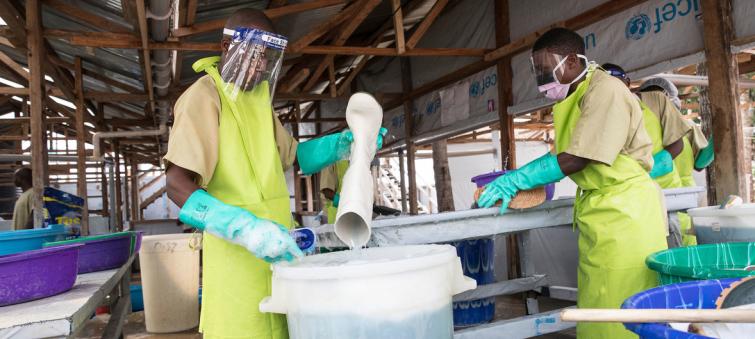
Photo caption and credit:
UN Photo/Martine Perret
Staff at the Katwa Ebola treatment Unit in Butembo in the east of the Democratic Republic of the Congo disinfect boots and wash clothes. (August 2019)
Support Our Journalism
We cannot do without you.. your contribution supports unbiased journalism
IBNS is not driven by any ism- not wokeism, not racism, not skewed secularism, not hyper right-wing or left liberal ideals, nor by any hardline religious beliefs or hyper nationalism. We want to serve you good old objective news, as they are. We do not judge or preach. We let people decide for themselves. We only try to present factual and well-sourced news.
Support objective journalism for a small contribution.


