


There is an acute shortage of general physicians, say doctors at medical conference
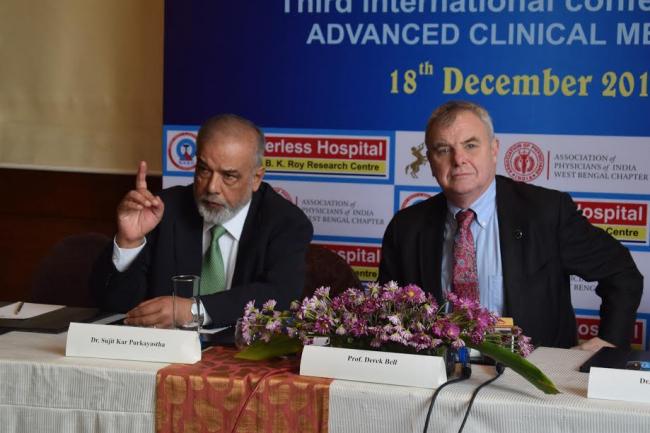
The two day seminar was organised by Peerless Hospital and B.K. Roy Research Centre, Royal College of Physicians of Edinburgh, UK and Association of Physicians of India (West Bengal chapter).
Professor Derek Bell of Royal College of Physicians of Edinburgh, Dr. Sujit Kar Purkayastha, Dr. Asokananda Konar, Dr. Debasis Datta and Dr. Ajoy Krishna Sarkar addressed the media on the sidelines of the Conference about the pressing issues in the field of practising medicine, such as dangers of specialisation and the need for awareness among the masses.
Speaking on the rapid commercialization of the health sector, Professor Bell said, "Even in the UK, doctors specialise early. What we need is to make the general training more attractive. It should be just as attractive to be a general physician as it is to be a specialist; so that a general physician gets as much credit and recognition as a specialist does.”
Commenting on the same issue, Dr. Purkayastha said, "In our country, the problem is that there is no well formulated course for general practitioners. As a result, young doctors are going into specialization right after passing out from their medical school. A large number of these doctors are self trained, with no formal training, and are ill-equipped to handle the general problems. This is in contrast with the earlier times when the general practitioners were in abundance and could guide the patients to the right specialist. Now there is a huge gap between the two.”
“It is very true that technology has progressed very rapidly, and it is a part and parcel of the healthcare sector. However, with the progress in technology, it is equally important to be equipped with a super fast brain with the capability of using and applying that technology. If a patient is complaining of chest pain goes to a cardiologist, and the doctor performs an angiogram, even if the patient does not necessarily need it, then it is improper use of technology. This is one of the major issues of our country,” he elaborated.
“Some of the other issues that need to be addressed are things like clear consultations with the patients. Doctors often see a patient for just five minutes and then the patient walks out but many important issues are not discussed. These things need to change. Just as there is corruption in politics, in every other field, there is corruption in the healthcare sector too, and no one likes it. But not every doctor indulges in corrupt practices," said Dr. Konar.
“Doctors need to be caring too. A five minute consultation does not always allow that. Caring needs to be a vital part of the curriculum, and consultations should be of a certain duration, say 20 minutes to even half an hour to allow that," said Bell.
“Alcoholism, obesity, diabetes, and even smoking, we have not been able to conquer them yet. A lot of awareness building is required," said Bell.
(Reporting by Tanushree Sen)
Support Our Journalism
We cannot do without you.. your contribution supports unbiased journalism
IBNS is not driven by any ism- not wokeism, not racism, not skewed secularism, not hyper right-wing or left liberal ideals, nor by any hardline religious beliefs or hyper nationalism. We want to serve you good old objective news, as they are. We do not judge or preach. We let people decide for themselves. We only try to present factual and well-sourced news.
Support objective journalism for a small contribution.


