


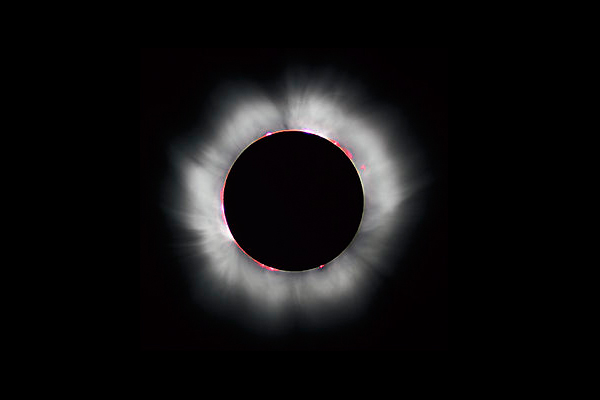
Total eclipse of Sun to occur on Mar 9, partial phase is to be visible in India
From India it will be seen as partial solar eclipse at sunrise.
"The same will be visible from most places of India except from North West and western parts of the country. In most places of India, the partial phase of the eclipse begins before sunrise i.e. partially eclipsed sunrise will take place. However, start of partial phase of the eclipse will take place just after sunrise from extreme north east India. As one moves towards the east of the country, the duration of the partial eclipse increases reaching upto a duration of about one hour and more in extreme north east India and in Andaman and Nicobar Islands, read the statement.
Considering the Earth as a whole the partial phase of the eclipse will begin at 4 h 49 m IST. The total phase will begin at 5 h 47 m IST. The total phase will end at 9 h 08m IST. The partial phase will end at 10h 05m IST.
"In India obscuration of the Sun by the Moon at the time of greatest phase of partial eclipse will be around 15 percent in Agartala, 24.5 percent in Bhubaneswar, 11 percent in Guwahati, 18.5 percent in Kolkata, 12 percent in Patna, 49 percent in Port Blair, 12 percent in Silchar etc," read the statement.
However, the greatest phase of the partial eclipse will not be seen from many places in India as the sunrise will take place after the time of occurrence of greatest phase at these places.
The Moon's penumbral shadow produces a partial eclipse, visible in the region covering South East Asia including India, Thailand, Indonesia, South Korea, Japan, Australia and the North Pacific Ocean.
The total eclipse of the Sun would be visible within a narrow corridor in the northern Hemisphere. The totality path would passe through Sumatra, Borneo, Indonesia and the North Pacific Ocean.
Eclipsed Sun should not be viewed with the naked eye, even for a very short time. It will cause permanent damage of the eyes leading to blindness even when the moon covers most portion of the Sun. Safe technique to observe the solar eclipse is either by using proper filter like aluminized Mylar, black polymer, welding glass of shade number 14 or by making projection of Sun’s image on a white board by telescope.
Support Our Journalism
We cannot do without you.. your contribution supports unbiased journalism
IBNS is not driven by any ism- not wokeism, not racism, not skewed secularism, not hyper right-wing or left liberal ideals, nor by any hardline religious beliefs or hyper nationalism. We want to serve you good old objective news, as they are. We do not judge or preach. We let people decide for themselves. We only try to present factual and well-sourced news.
Support objective journalism for a small contribution.


