Trees in ‘green’ Cameroon refugee camp, bring shade and relief from ‘helter-skelter’ of life
New York, Mar 2 (IBNS): The land is sandy, dry and scorched by the searing sun of the African Sahel, but that has not stopped the planting of some 50,000 trees at a camp for Nigerian refugees in the far north-east corner of Cameroon.
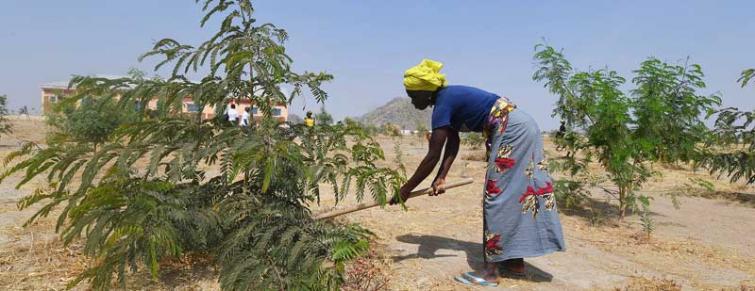
Small trees, including neem, acacia, moringa, leucaena and moringa, dot the landscape of the Minawao camp where some 56,000 Nigerians have sought shelter from violence in their homeland. They have escaped the terror and brutal treatment meted out by the outlawed Boko Haram extremist group which has been attacking villages along the border with Cameroon for over a decade.
As in all refugee camps, life can be tough, but the residents of Minawao told UN News during a visit to the camp in February, that they have been working to plant trees in order to create a greener and more environmentally-friendly camp.
“When there are no trees,” explained refugee representative Luka Isaac, “you can’t rest, you have to run around helter-skelter looking for shade in order to relax.”
When the refugees started arriving in Minawao in May 2013, some 30 kilometers from the Nigerian border, the local environment bore the full force of their presence. “Most people thought they would be here for just two or three months,”
“So, they ripped up trees for firewood and left nothing but sand and rocks,” Luka Isaac told UN News.
Deforestation
The uprooting of trees in Minawao is a part of a wider problem of deforestation in north-east Cameroon, where the fragile landscape has been degraded by unsustainable cultivation practices and rising temperatures caused by global warming.
The arrival of close to 60,000 extra people has also put a huge pressure on a region where natural resources are scarce and desertification is already under way.
‘Make Minawao green again’
The "Make Minawao green again" project aims to reverse deforestation both in the camp and surrounding villages. The project led by Lutheran World Federation (LWF) and supported by UNHCR, the UN Refugee Agency, has so far planted 50,000 trees over a 600 hectare area; it is hoped that an additional 5000 trees will be planted every year. Some are planned in groves, others are located in front of dwellings.
The different species of trees have been chosen for a number of reasons, according to LWF’s Luc Pemha. “They are mostly very quick to grow,” he said “When they are mature some can provide firewood, others, like neem, have medicinal properties. We are hoping also in the future to plant fruit trees which will provide food.”
Across Minawao camp, the inhabitants are able to find shade and a respite from the midday sun under small trees planted just two years ago. Smaller saplings are protected by netting or the thorny branches of the acacia tree. “The people who live here and in the surrounding villages have seen the difference the trees can make to everyday life,” said Mr. Pemha, “so they respect them and allow them to grow.”
UNHCR, which runs the camp, has one eye on the present and one on the future. “It’s important that we create a sustainable environment which benefits both host and refugee communities,” said Fanta Nifaboum, the agency’s deputy chief in Maroua, Cameroon. “And when the refugees ultimately return home, they will leave behind a greener and more developed village.”
Image Credit: UNHCR/Xavier Bourgois
Support Our Journalism
We cannot do without you.. your contribution supports unbiased journalism
IBNS is not driven by any ism- not wokeism, not racism, not skewed secularism, not hyper right-wing or left liberal ideals, nor by any hardline religious beliefs or hyper nationalism. We want to serve you good old objective news, as they are. We do not judge or preach. We let people decide for themselves. We only try to present factual and well-sourced news.
Support objective journalism for a small contribution.