


UK: Natural History Museum receives 100 mg sample of asteroid Bennu
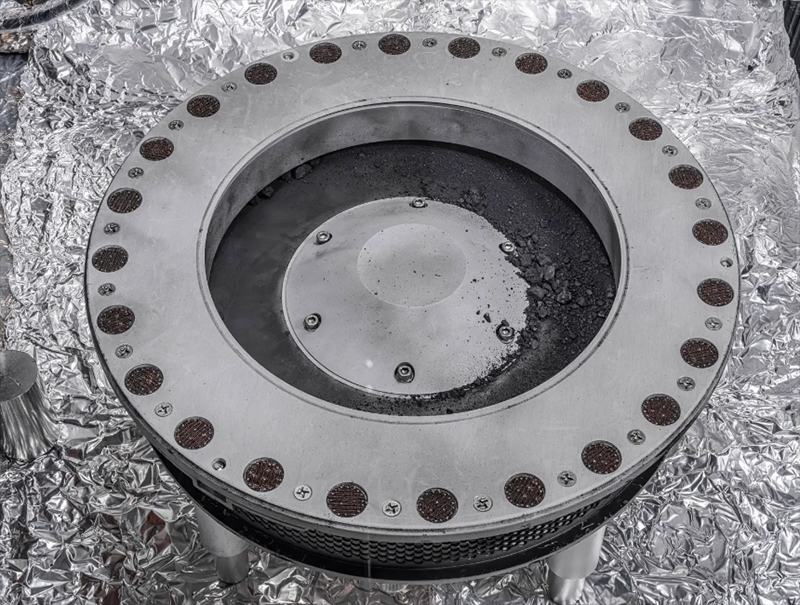
The Natural History Museum in the UK has received 100mg of the asteroid Bennu for study.
The teaspoon amount of matter holds vitals clues to the formation of the planets and our solar system.
In September this year NASA’s OSIRIS-REx (Origins, Spectral Interpretation, Resource Identification and Security – Regolith Explorer), became the first U.S. mission to collect a sample from an asteroid and return it to Earth, read a statement issued by the Natural History Museum.
That sample has now been dispersed among an international team with the aim of unravelling some of the biggest mysteries of our solar system.
Bennu is a carbon rich asteroid, containing roughly 5% by mass, some of which is organic. It is hoped that these organic compounds could help us to understand the origins of life on Earth.
The team also believe Bennu could have extraterrestrial water trapped within its minerals.
Studying the composition of these minerals will help the team test the theory that asteroids delivered water to our planet 4.5 billion years ago.
Prof Sara Russell, Senior Research Lead, Natural History Museum, said, "We have been waiting seven years for the sample to return to Earth, so it is hugely exciting for us to now have some of it here at the Natural History Museum."
"This material, no more than about a teaspoons worth, will keep us busy for years as we study each minute grain to understand its composition and structure and see what secrets we can unlock," Sara Russell said.
Asteroid Bennu is thought to be similar in composition to the Winchcombe meteorite which fell to Earth in 2021. Whilst the quick collection of the Winchcombe meteorite made it relatively un-contaminated, it still interacted with our atmosphere.
The Bennu samples, having been collected in space, remain uncontaminated, making them pristine time capsules from the earliest history of our solar system.
Ashley King, UKRI Future Leaders Fellow, Natural History Museum, added, "The Natural History Museum has one of the best meteorite collections in the world but for many of them we don’t know where they came from in the solar system. With this sample having been collected by NASA from asteroid Bennu’s surface, we know its origins. This means our findings can be put into a greater context and can potentially help us to understand the origin of organics and water that may have led to life on Earth."
The Museum is one of four UK institutes studying samples from NASA, along with the Open University, Oxford University and the University of Manchester.
The Musuem’s research team includes Ashley King, Dr Helena Bates, Dr Paul Schofield, Dr Natasha Almeida, Catherine Harrison, and Prof Sara Russell.
Support Our Journalism
We cannot do without you.. your contribution supports unbiased journalism
IBNS is not driven by any ism- not wokeism, not racism, not skewed secularism, not hyper right-wing or left liberal ideals, nor by any hardline religious beliefs or hyper nationalism. We want to serve you good old objective news, as they are. We do not judge or preach. We let people decide for themselves. We only try to present factual and well-sourced news.
Support objective journalism for a small contribution.


