


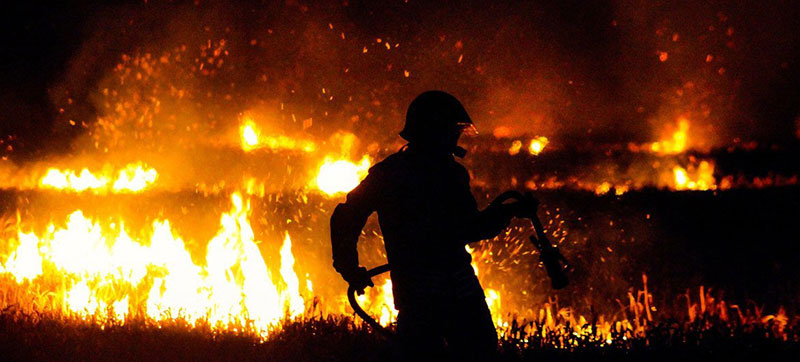
 Wildfire
UN-backed report warns of rising wildfire threat
New York: Wildfires are projected to rise by 50 per cent by the end of the century due to the climate crisis and changes in land use, according to a report published on Wednesday by the UN Environment Programme (UNEP) and GRID-Arendal, a non-profit environmental communications centre based in Norway.
The study found that even the Arctic and other regions previously unaffected by wildfires face elevated risk.
The authors call for a radical change in government response that focuses on prevention and preparedness.
Support and investment
They said that currently, money is often being put in the wrong place.
“Those emergency service workers and firefighters on the frontlines who are risking their lives to fight forest wildfires need to be supported. We have to minimize the risk of extreme wildfires by being better prepared: invest more in fire risk reduction, work with local communities, and strengthen global commitment to fight climate change,” said Inger Andersen, UNEP Executive Director.
The report, titled Spreading like Wildfire: The Rising Threat of Extraordinary Landscape Fires, has been released ahead of the resumed session of the UN Environment Assembly taking place in Nairobi, Kenya, next week.
Representatives from 193 countries will attend.
Health and wildlife affected
Wildfires disproportionately affect the world’s poorest nations, with impacts that last long after the flames subside – impeding progress towards sustainable development and deepening social inequalities.
Smoke from wildfires directly affects people’s health, for example, causing respiratory and cardiovascular impacts, while the cost of rebuilding can be beyond the means of low-income countries.
Wildlife, as well as natural habitats, are also rarely spared. Wildfires have even pushed some animal and plant species closer to extinction. The 2020 bushfires in Australia are estimated to have wiped out billions of domesticated and wild animals.
Climate link
Wildfires and climate change are “mutually exacerbating”, according to the report.
“Wildfires are made worse by climate change through increased drought, high air temperatures, low relative humidity, lightning, and strong winds resulting in hotter, drier, and longer fire seasons,” UNEP said.
“At the same time, climate change is made worse by wildfires, mostly by ravaging sensitive and carbon-rich ecosystems like peatlands and rainforests. This turns landscapes into tinderboxes, making it harder to halt rising temperatures.”
The report underscores the critical need to better understand the behaviour of wildfires. Prevention calls for a combination of data and science-based monitoring systems with indigenous knowledge, and for a stronger regional and international cooperation.
‘Fire Ready Formula’
Governments are urged to adopt a so-called “Fire Ready Formula”, which calls for two thirds of spending to be devoted to planning, prevention, preparedness and recovery – and one third for response.
Currently, direct responses to wildfires receive over half of related expenditure, with less than one per cent allocated for planning and prevention, according to the report.
The authors further call for stronger international standards for the safety and health of firefighters and for reducing the threats they face on the job.
This includes raising awareness of the risks of smoke inhalation, minimizing the potential for life-threatening entrapments, and providing them with access to adequate hydration, nutrition, rest, and recovery between shifts.
Support Our Journalism
We cannot do without you.. your contribution supports unbiased journalism
IBNS is not driven by any ism- not wokeism, not racism, not skewed secularism, not hyper right-wing or left liberal ideals, nor by any hardline religious beliefs or hyper nationalism. We want to serve you good old objective news, as they are. We do not judge or preach. We let people decide for themselves. We only try to present factual and well-sourced news.
Support objective journalism for a small contribution.


